State-of-the-Art Review
State-of-the-art review shows which kinds of solution exist for a technical problem, how each works and how far each has got, so you can choose what to investigate or trial. It is a Community skill, listed under Community in Capabilities, and is off until you select Turn on on its page. Once it’s on, you can start it, and GoVeda Agent can pick it when you describe the task in a chat.
- Depth: Quick covers 4–6 classes of solution, each with 2 representative patents and up to 4 web sources on how far it has got · Standard covers 5–8 classes, each with 3–5 representative patents or papers and up to 6 web sources, and checks again, at the source, the evidence for classes that reached demonstration or commercial operation
- Usually takes: Quick about 20–30 min · Standard about 30–55 min
- Usually costs: Quick about 750–1,050 credits · Standard about 2,400–3,700 credits
- Output: An answer in the chat, or a PDF if you ask
- Start it: Capabilities › State-of-the-art review › Turn on, then Start, or type
/in a chat once it’s on
When to use it
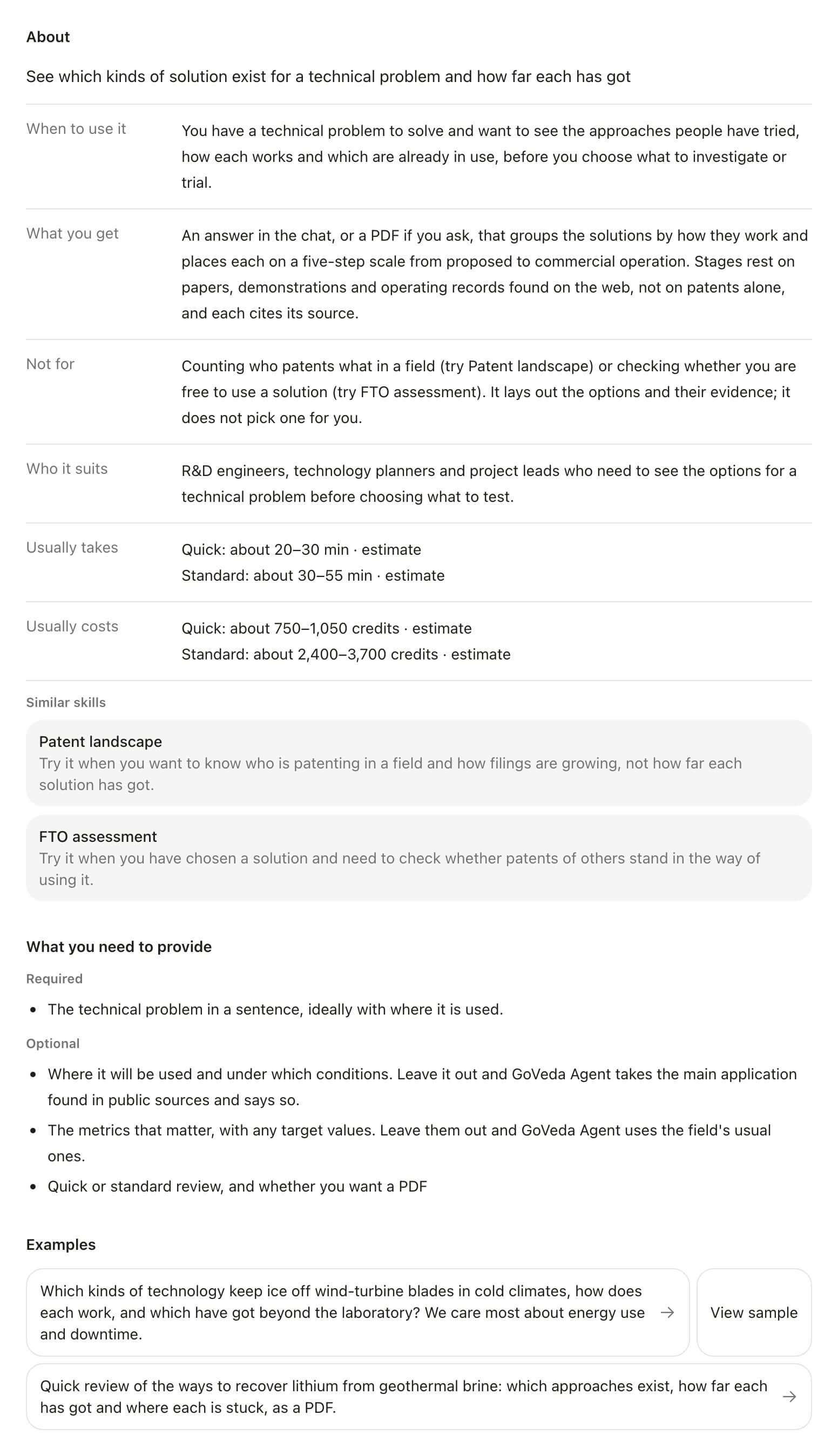
It suits R&D engineers, technology planners and project leads who need to see the options for a technical problem before choosing what to test.
Not for: Counting who patents what in a field (try Patent Landscape) or checking whether you are free to use a solution (try FTO Assessment).
What you need to provide
Required
- The technical problem in a sentence, ideally with where it is used. A field alone, such as “batteries”, is not a problem, so GoVeda Agent asks what you want solved.
Optional
- Where it will be used and under which conditions. Leave it out and GoVeda Agent takes the main application found in public sources and says so.
- The metrics that matter, with any target values. Leave them out and GoVeda Agent uses the field’s usual ones.
- Solutions you already use or know. GoVeda Agent keeps them in the review as a reference point.
- Quick or Standard, and whether you want a PDF.
You don’t need to give search terms or the classes of solution. GoVeda Agent works them out and explains how it grouped them. It asks for anything that is missing in a card titled A question from GoVeda Agent. For depth and budgets, see Quick or Standard.
What you get
The answer groups the solutions by how they work and places each on a five-step scale from proposed to commercial operation. Stages rest on papers, demonstrations and operating records found on the web, not on patents alone, and each cites its source.
| Stage | What the evidence must show |
|---|---|
| Proposed | Described in a patent or paper; no working test found |
| Laboratory | Measured on samples or bench rigs, at small scale |
| Prototype | A working unit at representative scale, tested under controlled conditions |
| Demonstration | Run in the target setting at pilot or full scale, for a limited time or at one site |
| Commercial operation | In regular use for this problem, shown by an operator’s or independent record, or by a named product on sale |
Patents alone place a solution at Proposed, and a supplier’s own account of a customer or site counts up to Demonstration. The answer includes:
- Key findings: which classes are in use for this problem and which have only laboratory or patent evidence, the main unsolved problem, and what to look at next.
- The problem and scope, with each assumption marked.
- A technology map: the classes, how they relate, and an overview table with each class’s principle, stage, key metric, main advantage and main bottleneck.
- A section for each class: how it works, where it works and where it does not, an evidence table with conditions and sources, representative implementations, and its bottlenecks.
- Shared bottlenecks, conflicting results, and two to four directions worth investigating or trialling under your conditions.
- Sources grouped by class, with links.
Example requests
Which kinds of technology keep ice off wind-turbine blades in cold climates, how does each work, and which have got beyond the laboratory? We care most about energy use and downtime.Quick review of the ways to recover lithium from geothermal brine: which approaches exist, how far each has got and where each is stuck, as a PDF.Before you rely on it
Patents alone do not show that a solution works or is in use. The review states what public sources found by the cut-off date support. A search can miss work, and not finding something does not show that it does not exist. Figures measured under different conditions are shown side by side, not ranked. In Quick, stages are not checked a second time. The review does not judge novelty, patentability, infringement or market entry, and it does not choose a route for you.
Related
- Patent Landscape: try it when you want to know who is patenting in a field and how filings are growing, not how far each solution has got.
- FTO Assessment: try it when you have chosen a solution and need to check whether patents of others stand in the way of using it.
- Your Own Skills: save your own variant, for example with your maturity checks and the metrics your team uses.