Patent Landscape
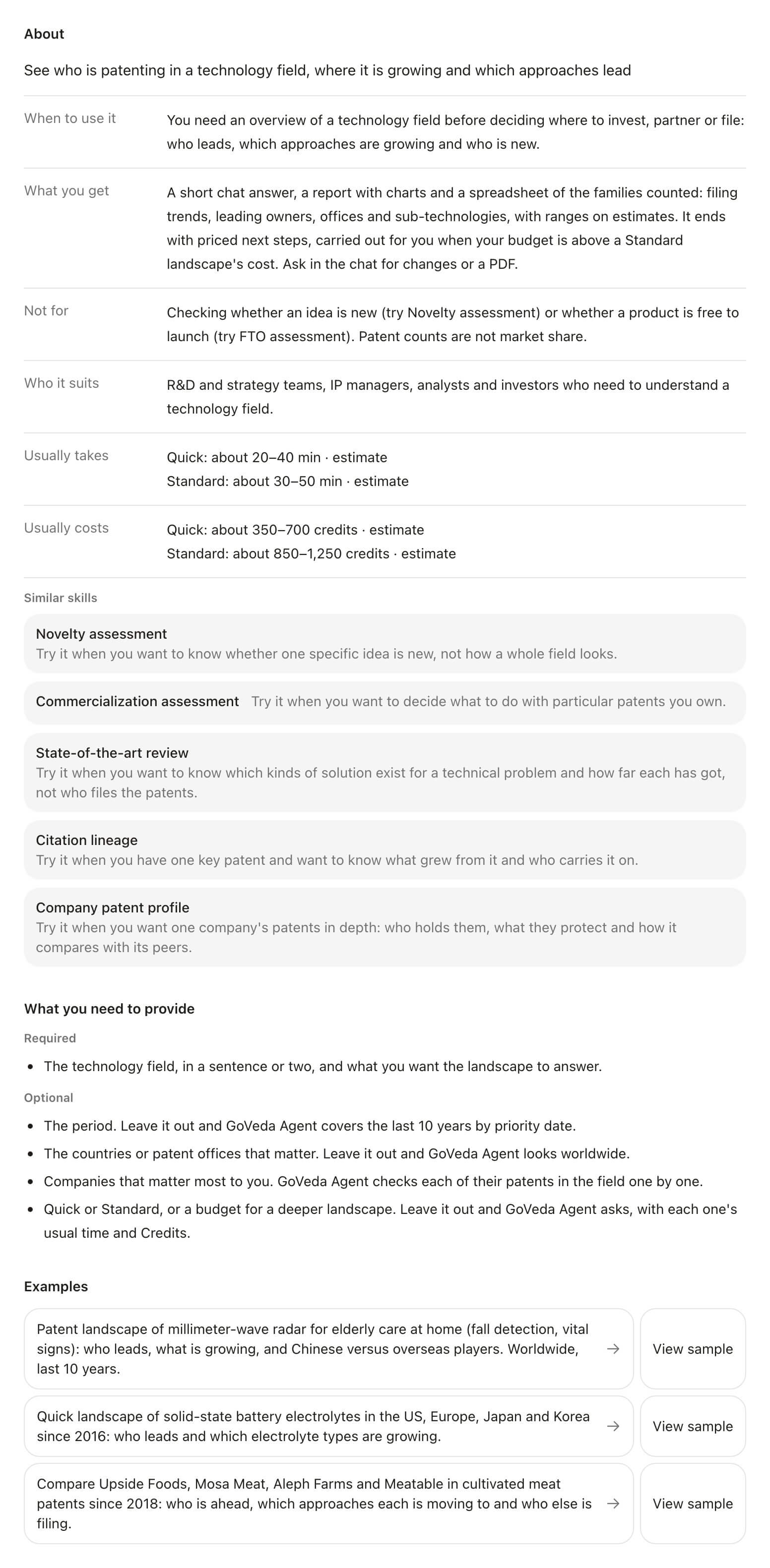
Patent landscape shows who is patenting in a technology field, where filing is growing, which approaches lead and who is new, so you can decide where to invest, partner or file. It is one of GoVeda’s own skills, listed under GoVeda in Capabilities.
- Depth: Quick screens a sample of about 320 patent families, plus every family of the companies you name, for a report of about 6 pages · Standard screens about 1,000, with up to 3 leading companies screened in full and unclear families read again with their claims, for about 15 pages
- Usually takes: Quick about 20–40 min · Standard about 30–50 min
- Usually costs: Quick about 350–700 credits · Standard about 850–1,250 credits
- Output: A short answer in the chat, a report with charts and a spreadsheet (CSV) of the families counted, or a PDF if you ask
- Start it: Capabilities › Patent landscape › Start, or type
/in a chat
When to use it
It suits R&D and strategy teams, IP managers, analysts and investors who need to understand a technology field.
Not for: Checking whether an idea is new (try Novelty Assessment) or whether a product is free to launch (try FTO Assessment). To see which kinds of solution exist for a technical problem and how far each has got, try State-of-the-Art Review.
What you need to provide
Required
- The technology field, in a sentence or two, and what you want the landscape to answer. If the field is only a word, such as “batteries”, GoVeda Agent proposes a narrower boundary.
Optional
- The period. Leave it out and GoVeda Agent covers the last 10 years by priority date.
- The countries or patent offices that matter. Leave it out and GoVeda Agent looks worldwide.
- The companies whose patents matter most to you, such as competitors, partners or your own. Each of their patents in the field is judged one by one.
- Quick or Standard, and whether you want a PDF.
Before it starts, GoVeda Agent proposes the field’s boundary and its sub-technologies and asks you to correct them, together with the two to four questions the landscape should answer. It asks this, and anything else that is missing, in a card titled A question from GoVeda Agent. For depth and budgets, see Quick or Standard.
What you get
A short answer to each of your questions in the chat, with a report with charts and a spreadsheet of the families counted. Patent families matching the field are screened for whether they are really on topic, and only those count. Counts from a sample are estimates with ranges, and the report says what was not screened in full. The report includes:
- Key findings, each answering one of your questions with its numbers.
- Scope and method: the field’s boundary and sub-technologies, the search terms and classification codes that define it, and how many families were screened and found on topic.
- The filing trend by priority year, and in Standard for each sub-technology. The last two years are incomplete because applications publish about 18 months after filing.
- The organizations: the top current owners and the leaders of each sub-technology. Owner names that belong to the same company or group are merged, and the report says which.
- Geography: the offices where families are filed and the countries of first filing.
- Each sub-technology’s size, growth and leaders.
- In Standard, also the share of on-topic families still alive, new entrants, and observations worth a closer look.
- Next steps, each with its usual minutes and credits, such as screening a company in full or reading unclear families again. With a budget above a Standard landscape’s cost, GoVeda Agent carries them out for you.
Counts are patent families, counted by earliest priority year. To change the report, ask in the same chat: expand, shorten, add or remove a section, or correct a fact, such as two owner names that are one company. GoVeda Agent revises the saved report rather than starting again.
Example requests
Patent landscape of millimeter-wave radar for elderly care at home (fall detection, vital signs): who leads, what is growing, and Chinese versus overseas players. Worldwide, last 10 years.Quick landscape of solid-state battery electrolytes in the US, Europe, Japan and Korea since 2016: who leads and which electrolyte types are growing.Before you rely on it
Patent counts are not market share. They count patent families, not products or sales, and the most recent years are incomplete. A low count can reflect the search terms rather than an opening, so do not read it as proof of a commercial opportunity or freedom to operate. A landscape does not show whether an idea is new or a product is free to launch; legal questions belong with a patent attorney.
Related
- Novelty Assessment: try it when you want to know whether one specific idea is new, not how a whole field looks.
- Commercialization Assessment: try it when you want to decide what to do with particular patents you own.
- State-of-the-Art Review: try it when you want to know which kinds of solution exist for a technical problem and how far each has got, not who files the patents.
- Your Own Skills: save your own variant, for example with your counting rules and report structure.