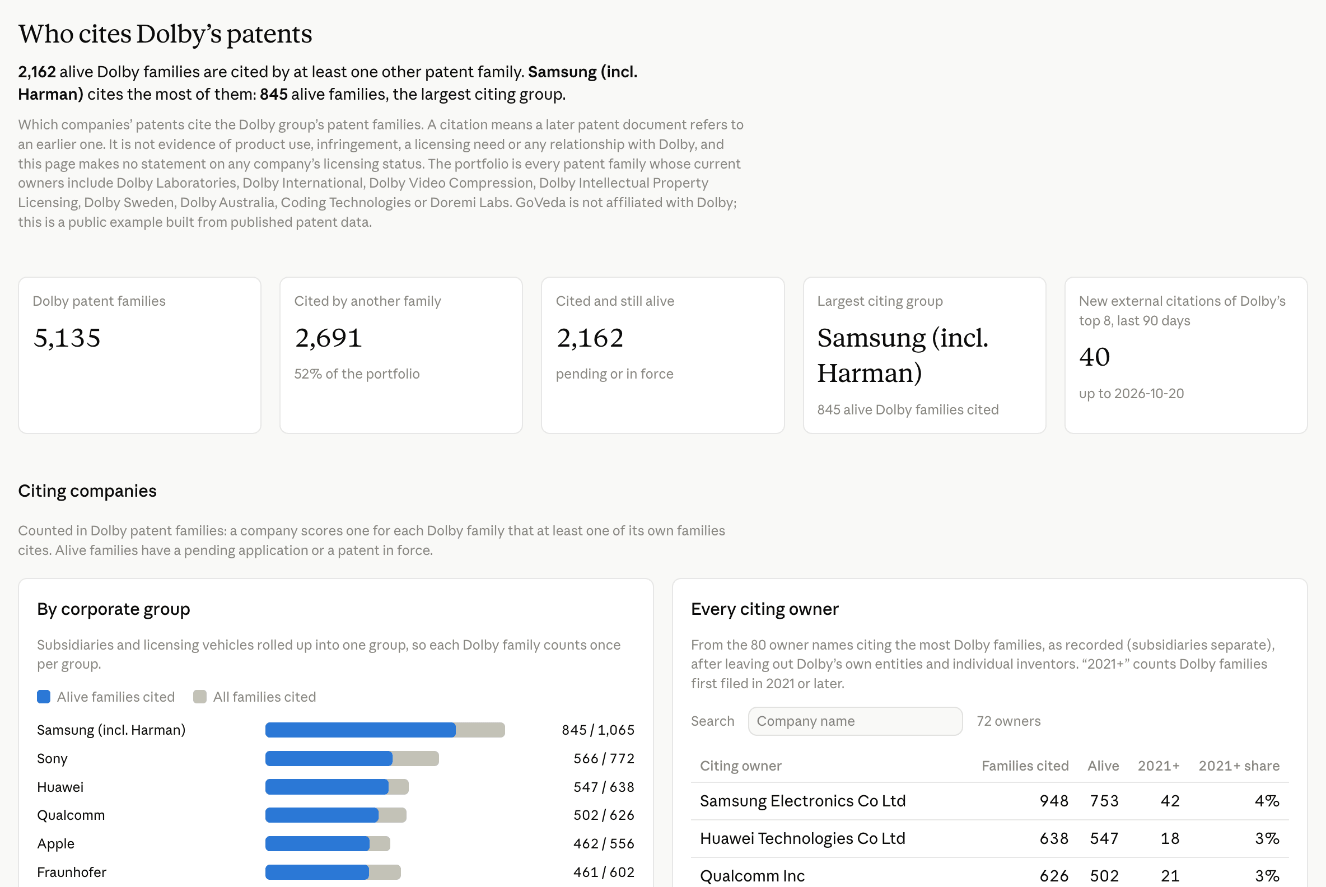
This is a patent citation dashboard we built in Claude. It shows which companies cite a patent portfolio, which of the portfolio’s families they build on, and who cites its newest filings, and every number comes from a live query to the GoVeda patent database.
Licensing and IP teams often look at forward citations: later patents that cite their own. Repeated citations can suggest that a company files in related technology, which some teams use to decide where to research further. The data is public, but turning it into a ranked list of companies usually takes a spreadsheet and an afternoon, and the list is out of date the next month. With Claude Dashboards , in beta on paid Claude plans since October 8, 2026, the list lives in a dashboard that reruns its queries through the GoVeda Patent connector. This post covers what the dashboard shows, how to build one with a single prompt, what it found for an example portfolio, and how to read citations without over-reading them.
What does a patent citation dashboard show?
We used Dolby’s portfolio as a public example: it is large, spread across many owner entities, including subsidiaries and acquired companies, and widely cited, so it shows how the dashboard handles name variants and corporate groups. GoVeda is not affiliated with Dolby, and the dashboard uses only published patent data. The portfolio covers every family whose current owners include one of 15 Dolby group owner names, such as Dolby Laboratories Licensing Corp and Dolby International AB.
The dashboard has five parts:
| Part | Question it answers |
|---|---|
| Headline figures | How much of the portfolio do later patent families cite, and how much of that is still alive? |
| Citing companies, by corporate group | Which groups cite the most of the portfolio’s families? |
| Most-cited alive families | Which of the portfolio’s inventions draw the most citations, and from whom? |
| Rising and new citers | Who cites the portfolio’s newest filings, and which companies appear in the latest citations of its most-cited families? |
| Cited families by filing year | Which generations of the portfolio get cited? |
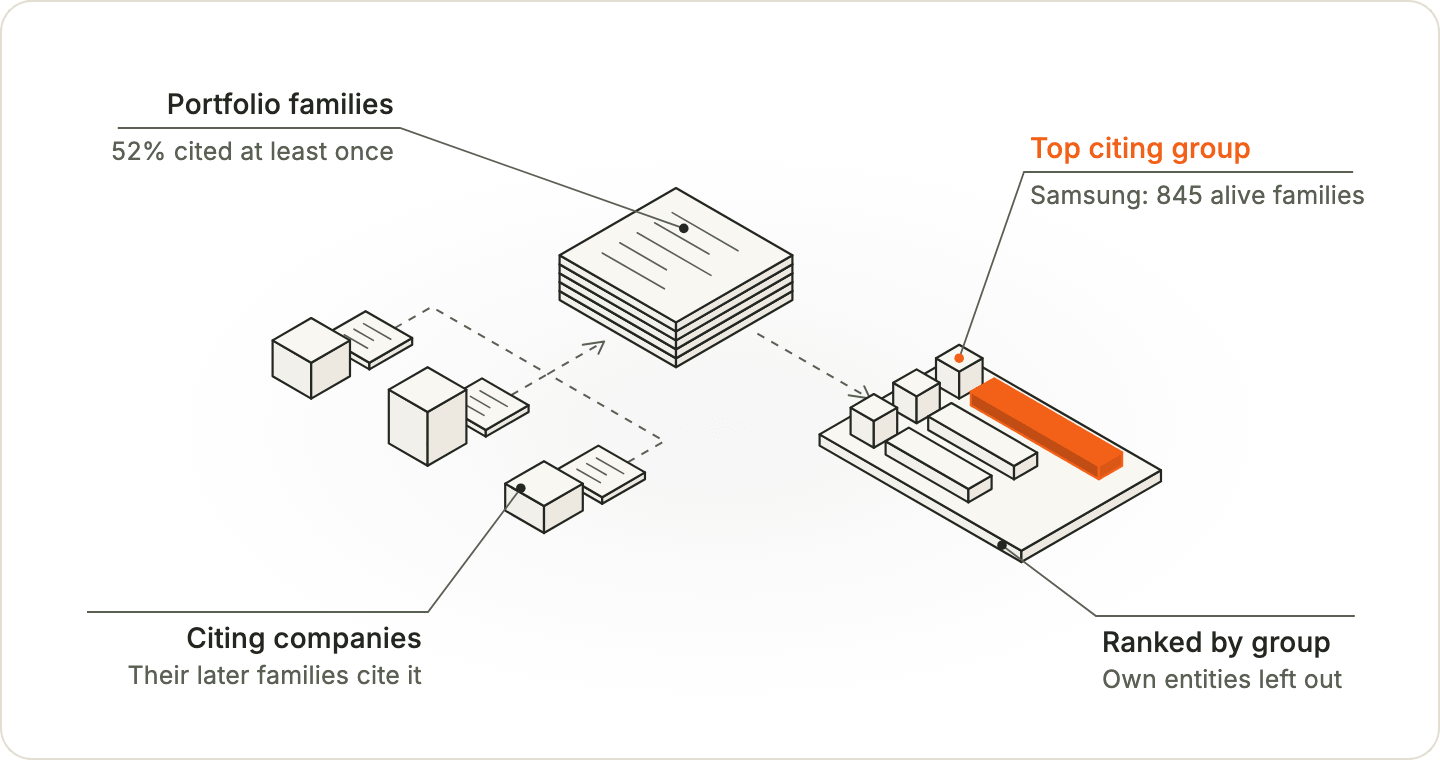
The ranking counts patent families, not citations. A company scores one for each of the portfolio’s families that at least one of its own families cites, so a company that cites the same family many times still scores only one for it.
How is a live dashboard different from a one-off page?
If you ask Claude for a chart of who cites a portfolio, Claude may build a one-off page rather than a live dashboard: it runs the queries once, writes the results into the page and hands it over. A live dashboard keeps the queries, so it goes back to the patent database whenever you open it.
| One-off page | Live dashboard | |
|---|---|---|
| Data | A snapshot from the day it was made | The latest data in the GoVeda database every time you open it |
| New citations | Missing until you ask Claude to rebuild the page | A newly published citing document is included once the database records it |
| New citing companies | Fixed to the companies found that day | A company that starts citing the portfolio is picked up without a rebuild, and appears in the ranking once it cites enough families to place among the top citers |
| Most-cited families | Ranked as of the day the page was made | Re-ranked from current citation counts each time |
| Trust | Figures on their own | Every figure links to the query behind it, and the rows that query returned can be downloaded as CSV |
| Upkeep | Rebuild and re-check for each update | Build once, reuse every month |
| Team use | Everyone works from the same old copy | Each colleague sees current data through their own GoVeda connection |
A one-off page is fine for a snapshot you want to keep as it is, such as a citation list attached to a report. For anything you follow over time, such as who cites a portfolio, the dashboard does the rebuilding for you, and each new citation in it is still a lead to research, not a finding.
How do you build one in Claude?
Connect GoVeda Patent
Add GoVeda Patent from Claude’s connector directory and sign in once. Using GoVeda Patent Inside Claude shows each step, and the competitor monitoring dashboard post shows another dashboard built the same way.
Paste this prompt
Copy the prompt into a new Claude chat:
I want a dashboard in Claude that shows which companies cite a patent
portfolio, using GoVeda Patent data.

Before you build anything, confirm the scope with me:
- Ask whose patent portfolio to monitor. Then use GoVeda to find every
  patent-owner name of that group, including subsidiaries, acquired
  companies and licensing entities, and show me the list to confirm.
- Ask whether to limit the portfolio to a technology area or to
  particular patent offices.

The dashboard should show:
- how many of the portfolio's patent families are cited by other
  families, and how many of those are still alive
- the companies whose families cite the most of the portfolio's
  families, rolled up into corporate groups, split by alive families
  and by families filed in the last five years
- the portfolio's most-cited alive families and who cites each one
- which filing years of the portfolio get cited
- the newest citations of the most-cited families, and companies that
  cite the portfolio's newest filings

Leave the portfolio owner's own entities out of the citing companies.
Prefer statistics queries over per-patent calls, keep the data live,
and tell me the credit cost per open before you build it.
Claude first asks which portfolio to monitor and looks up every owner name of that group, because a portfolio is often spread across subsidiaries and licensing entities. It shows you the list to confirm before it builds anything. After that, ask for changes in the same chat: another breakdown, a different window for “recent”, or a filter by technology area.
What does the citation data show for Dolby’s portfolio?
The figures below count simple patent families: one invention filed in several countries counts once. The companies named below appear only because their published patent documents cite Dolby-owned families. A citation is not evidence of product use, infringement, a licensing need or any relationship with Dolby, and we have no information about, and make no statement on, any company’s licensing status or business relationship with Dolby.
- About half the portfolio is cited. Of 5,135 Dolby families, 2,691 (52%) are cited by at least one other family. 2,162 of the cited families are still alive. The portfolio has 2,671 alive families in total, so 81% of them are cited.
- The largest citing groups are mainly device makers, chip makers and audio research organizations. Grouping each company’s owner names, the groups citing the most alive Dolby families are shown in the table below.
- Long-lived families keep drawing citations. An older family on spectral band replication for audio coding (US 7,328,162 B2 is one member), whose patents have expired, is cited by 432 other families. Among alive families whose latest expiration date has not passed, the most cited, on adaptive audio signal generation, coding and rendering (US 12,335,718 B2 is one member), is cited by 347.
- Newer filings draw different citers. Among companies citing Dolby families first filed in 2021 or later, several do not appear among the 80 owner names citing the most Dolby families overall. They include makers of computers, hearing aids, audio equipment and cars, each citing five to seven of those newer families.
- New citations keep arriving. In the 90 days up to October 20, 2026, 40 newly published documents owned by other companies cited at least one of Dolby’s 8 most-cited alive families.
| Citing group | Alive Dolby families cited | All Dolby families cited |
|---|---|---|
| Samsung (including Harman ) | 845 | 1,065 |
| Sony | 566 | 772 |
| Huawei | 547 | 638 |
| Qualcomm | 502 | 626 |
| Apple | 462 | 556 |
| Fraunhofer | 461 | 602 |
| Nokia | 406 | 505 |
Does a citation mean infringement?
No. A forward citation shows that a later patent document refers to an earlier one. It can come from the applicant, from the examiner or search authority when assessing whether a new application is new and inventive, or occasionally from a third party. A citation does not show:
- that the citing company sells a product using the cited invention
- that any claim of the cited patent covers anything the citing company does
- that the citing company needs, wants or lacks a license
What it does show is technical proximity: the citing company files in an area close to the cited family. That makes the ranking a way to decide where to look first. Any assessment of a company’s products against patent claims is a legal analysis for qualified counsel; the dashboard does not perform it.
How should you read the numbers?
A few conventions shape every figure on the dashboard:
- Families, not citations. The ranking counts how many of the portfolio’s families each company cites. Self-citations within one family do not count.
- Current owners. Citing companies are the current owners of the citing families. A patent sold after filing counts for its new owner.
- Name variants. One company can appear under several owner names, such as Sony Corp and Sony Group Corp. The corporate-group view merges the names listed in its query; the full ranking shows each name separately. The dashboard leaves out the portfolio owner’s own names, including spelling and script variants, and names that look like individual inventors.
- Alive families. A family is alive when at least one of its applications is pending or in force. Legal status comes from patent office records, which can lag, so the most-cited family lists also require a latest expiration date that has not passed. Alive status is a data label, not an opinion on whether a patent is valid or enforceable.
- Dates. The ranking does not say when a citation was made. Citation dates appear only in the feed of the most-cited families, which lists the 100 newest citations of each.
What does it cost to keep running?
Each time the example dashboard opens or refreshes, it makes 14 calls to GoVeda:
| Calls | Credits |
|---|---|
| 4 statistics calls (portfolio size, citing companies, citers of new filings, citation counts for the most-cited families) at 2 credits | 8 |
| 2 list pages of the most-cited families at 2 credits | 4 |
| 8 citation pages, one per most-cited family, at 1 credit | 8 |
| Total | 20 |
If you ask Claude to add a filter, changing it runs the queries that use it again at the same prices, for example 2 credits for each statistics call. Resolving company names is free. A list page costs 2 credits as long as it returns only the default patent record; asking it for extra fields such as citation counts adds 1 credit per patent, so the dashboard gets those counts from a statistics call instead. The MCP pricing page lists every tool’s price.
Each viewer runs the queries with their own GoVeda account, so colleagues need GoVeda connected in Claude to see the data, and their opens use their own credits.
Frequently asked questions
What is a forward citation?
A forward citation is a later patent document that cites an earlier one, usually because the applicant listed it or an examiner or search authority cited it during examination. Counting forward citations shows which patents later filings build on or are compared against.
Does a citation mean the citing company infringes the patent?
No. A citation only shows that a later patent document refers to an earlier one. It says nothing about the citing company’s products, whether any claim is practiced, or whether the company is interested in a license. Treat it as a lead to research, not as a finding.
How is a live dashboard different from a page Claude generates once?
A one-off page is a snapshot of the numbers from the day Claude made it. A live dashboard stores the queries instead, so it shows the latest citations in the GoVeda database every time it opens, re-ranks citing companies from current data, and every figure links to the query behind it.
Do I need to write code to build the dashboard?
No. You describe the dashboard in a Claude chat, confirm the portfolio and the scope Claude proposes, and Claude writes the page and the queries behind it.
What does the example dashboard cost to run?
20 GoVeda credits each time it opens or refreshes: four statistics calls at 2 credits, two list pages at 2 credits and eight citation pages at 1 credit.
This article is general information, not legal advice. For decisions on a specific matter, consult a qualified patent attorney or agent.
Dolby and other company names are trademarks of their respective owners and are used for identification only.