Commercialization Assessment
Commercialization assessment helps you decide what to do with a patent, a group of patents or a technology: license it, sell it, find a partner, start a company or build it yourself. It is one of GoVeda’s own skills, listed under GoVeda in Capabilities.
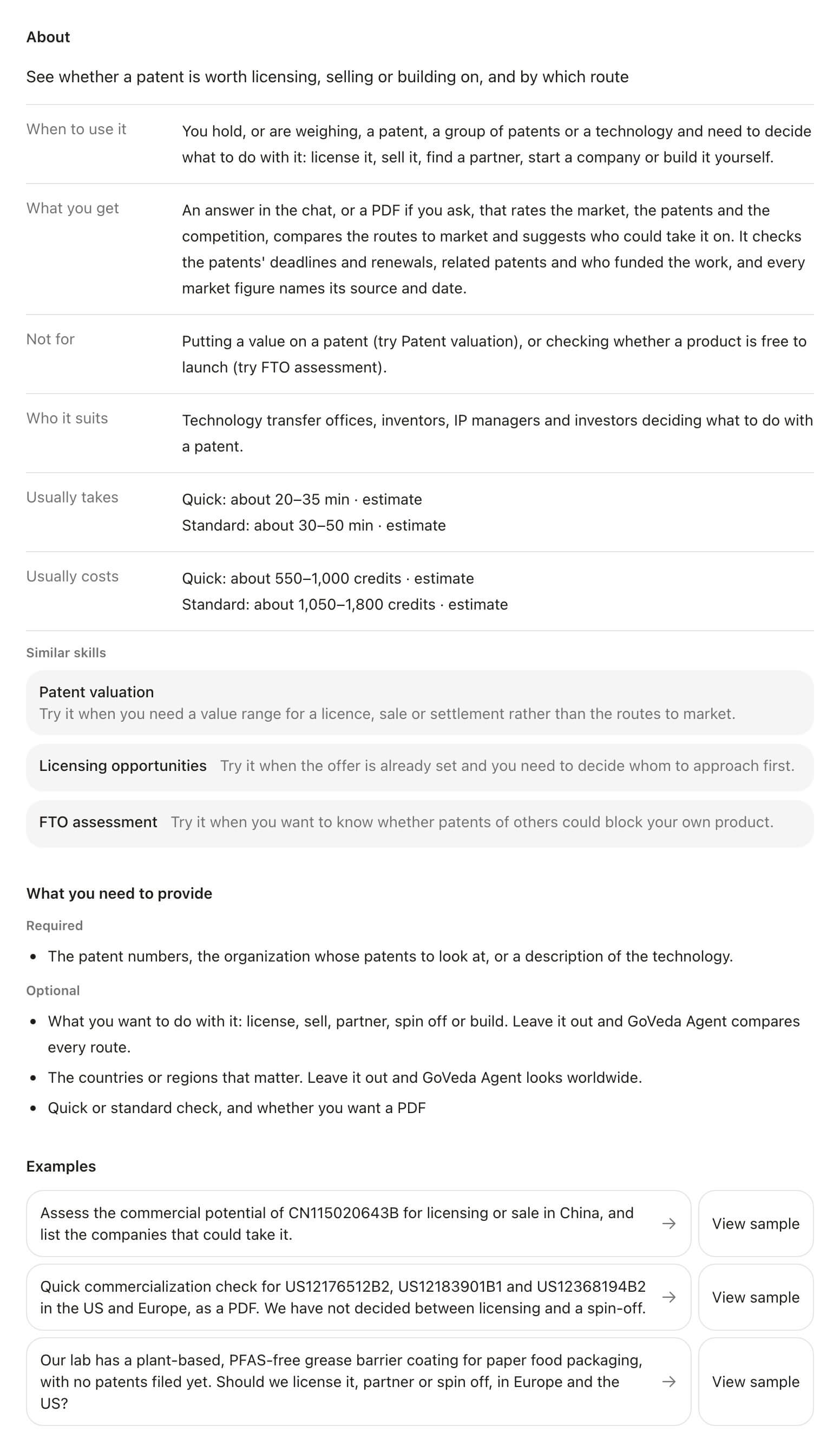
- Depth: Quick researches the 3 most promising applications and describes partner types · Standard researches up to 6 applications and names candidate partners, with the evidence for each
- Usually takes: Quick about 20–35 min · Standard about 30–50 min
- Usually costs: Quick about 550–1,000 credits · Standard about 1,050–1,800 credits
- Output: An answer in the chat, or a PDF if you ask
- Start it: Capabilities › Commercialization assessment › Start, or type
/in a chat
When to use it
It suits technology transfer offices, inventors, IP managers and investors.
Not for: Putting a price on a patent, or checking whether a product is free to launch (try FTO Assessment). For an overview of a field with no commercial question, try Patent Landscape. To compare the portfolios of several organizations, describe the task in a chat.
What you need to provide
Required
- The patent numbers, the organization whose patents to look at, or a description of the technology.
Optional
- What you want to do with it: license, sell, partner, spin off or build. Leave it out and GoVeda Agent compares every route.
- The countries or regions that matter. Leave it out and GoVeda Agent looks worldwide.
- Quick or Standard, and whether you want a PDF.
GoVeda Agent asks for anything that is missing in a card titled A question from GoVeda Agent. For depth and budgets, see Quick or Standard.
What you get
The answer rates the market, the patents and the competition, compares the routes to market and suggests who could take it on. It checks the patents’ deadlines and renewals, related patents and who funded the work, and every market figure names its web source and date. It includes:
- A conclusion: whether the technology is worth pursuing, in which application and by which route, and the main condition.
- The patents: status, expiry and countries; what the independent claims protect, in plain words; dated legal events such as open office actions and their deadlines; and the next renewal of each patent in force.
- Who funded the work and what that may mean for a transfer, the owner’s own offer of the technology if one was found, and the inventors’ related patents.
- The field around the technology: who files, how activity moves and the most cited live patents.
- Five ratings, each high, medium, low or unknown with its evidence: market demand, patent position, technical merit, competitive environment and financial potential. Unknown means the evidence is missing; it never counts as low.
- The applications, ranked, each with its market evidence, alternatives and the work still needed to use the technology there.
- The routes compared: licence, sale, joint development, spin-off and your own product, each with its conditions and risks.
- Potential partners: named organizations with evidence in Standard, types of organization in Quick.
- Transfer readiness: how far the technology has been shown to work, and what to settle before approaching anyone.
- Next steps, what was covered, and the sources used, with links.
Example requests
Assess the commercial potential of CN115020643B for licensing or sale in China, and list the companies that could take it.Quick commercialization check for US12176512B2, US12183901B1 and US12368194B2 in the US and Europe, as a PDF. We have not decided between licensing and a spin-off.Before you rely on it
This is a screening assessment from public patent and web information, not a patent valuation or an investment, legal or transaction opinion. It never puts a price or a royalty on a patent. Market figures come from the cited sources and describe markets, not the value of the patents. Named organizations are candidates to verify; their interest is unknown. Confirm status, deadlines and ownership in the office registers, and take professional advice before you decide.
Related
- Patent Landscape: try it when you want an overview of who is patenting in a whole field, not a decision about particular patents.
- FTO Assessment: try it when the question is whether a product is free to launch in certain countries.
- Your Own Skills: save your own variant, for example with your organization’s scope rules and evidence checks.