You’ll need the GoVeda MCP server connected first. It takes about a minute. See Connect to Claude or ChatGPT to set it up. Once it’s connected, just ask your question; your assistant reaches for GoVeda on its own when a patent task needs it. New accounts get a 14-day free trial with 10,000 credits.
A standard-essential patent (SEP) is one you can’t avoid infringing if you build a product to a standard like 5G, which makes SEPs among the most valuable and most heavily litigated patents a company owns. Working out which patents in a portfolio are likely essential is one of the hardest questions in IP, and it shows how carefully GoVeda reasons over claims. It’s useful for licensing talks, portfolio valuation, and sizing up a competitor.
The prompt
Open a new chat and paste:
Help me identify patents in Qualcomm’s portfolio that look like they could be standard-essential to the 5G NR standard. Find the strongest candidates and explain why each looks SEP-relevant — but be careful and honest about what can and can’t be concluded about essentiality from patent data alone.
What GoVeda does behind the scenes
Essentiality reasoning needs the right portfolio, the right technology areas, and the actual claim text. The assistant assembles all three before it ranks anything:
Resolve the portfolio
It calls lookup_party to pin Qualcomm to its exact assignee name, so the search is scoped to the right company.
Map the SEP-dense areas
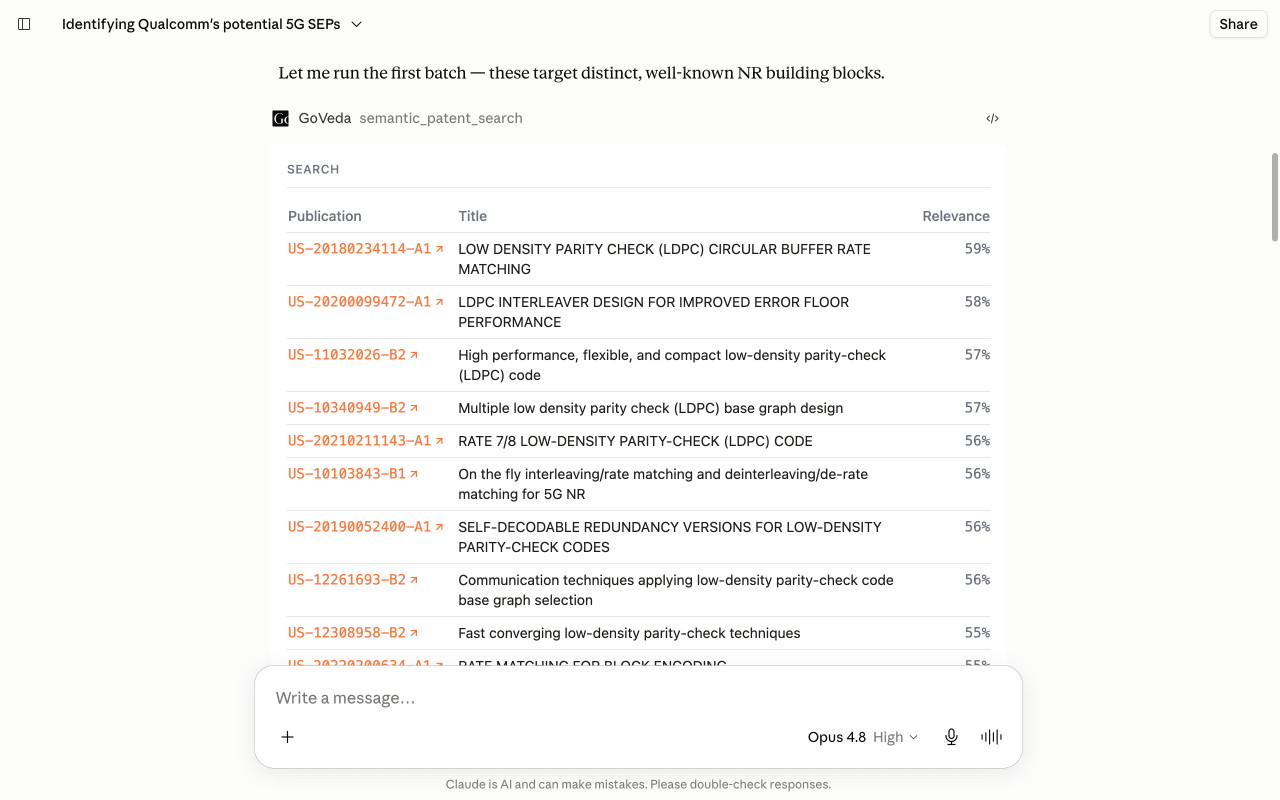
It uses lookup_classifications and targeted semantic_patent_search runs across the parts of 5G NR where essential patents cluster: LDPC and polar channel coding, random access, uplink control, and beam management.
Read the candidates’ claims
It pulls the independent claims of the strongest hits with batch_get_patents, because essentiality lives in claim language, not abstracts.
Map claims to the standard
It lines each claim up against the normative 3GPP mechanisms and ranks candidates by how cleanly they read onto the standard.
You can watch it work from portfolio to ranked candidates in the chat:
What you get
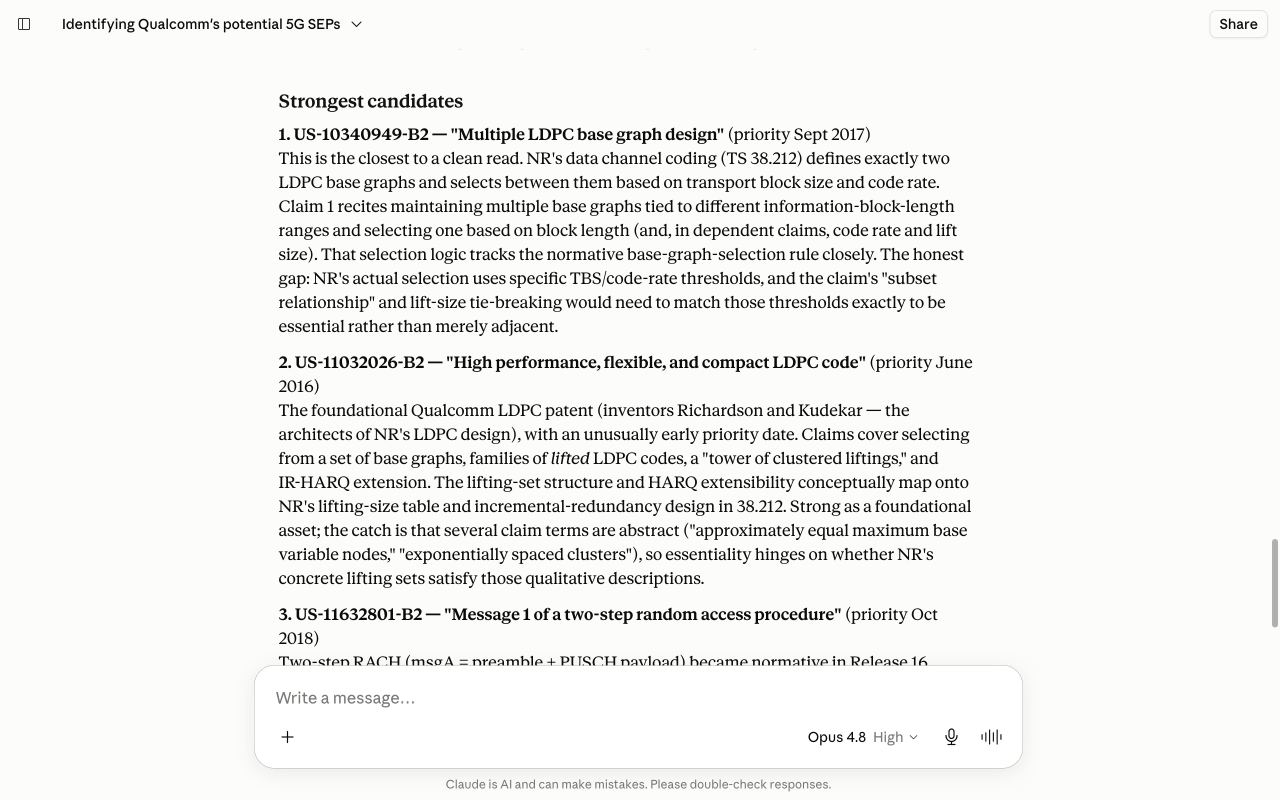
You get the strongest candidates ranked by how cleanly each reads onto the standard (an LDPC base-graph patent comes out near the top), each with the claim-to-spec reasoning spelled out. It ends with a rigorous caveat: essentiality can’t be confirmed from patent data alone. That honesty is the point.
Tips
This one is built for legal and technical audiences. The “can’t be concluded” disclaimer isn’t hedging. Declaring a patent essential requires claim-charting against the final standard text, which is a separate exercise.
Next: browse more use cases or read the MCP tool reference.