Semantic Patent Search: How to Find Patents by Meaning
What is semantic patent search?
Semantic patent search finds patents by the meaning of a plain-language description instead of by exact keyword matches. You describe a technology, a problem, or a product feature in your own words, and the search returns conceptually similar patents ranked by relevance. GoVeda runs this kind of search across 220 million+ patents from 108 jurisdictions, so a description of an idea surfaces related filings even when they use entirely different wording.
It helps to set semantic search next to the two other common approaches. Keyword search matches exact strings of text. Classification search matches the formal codes (CPC or IPC) assigned to each patent. Semantic search matches concepts. They work together rather than competing.
This is useful for anyone who needs to find relevant patents without already knowing the right jargon: inventors checking an idea, engineers scoping a feature, founders sizing up a field, and researchers running a first pass before they hand work to a professional searcher.
Why keyword search misses relevant patents
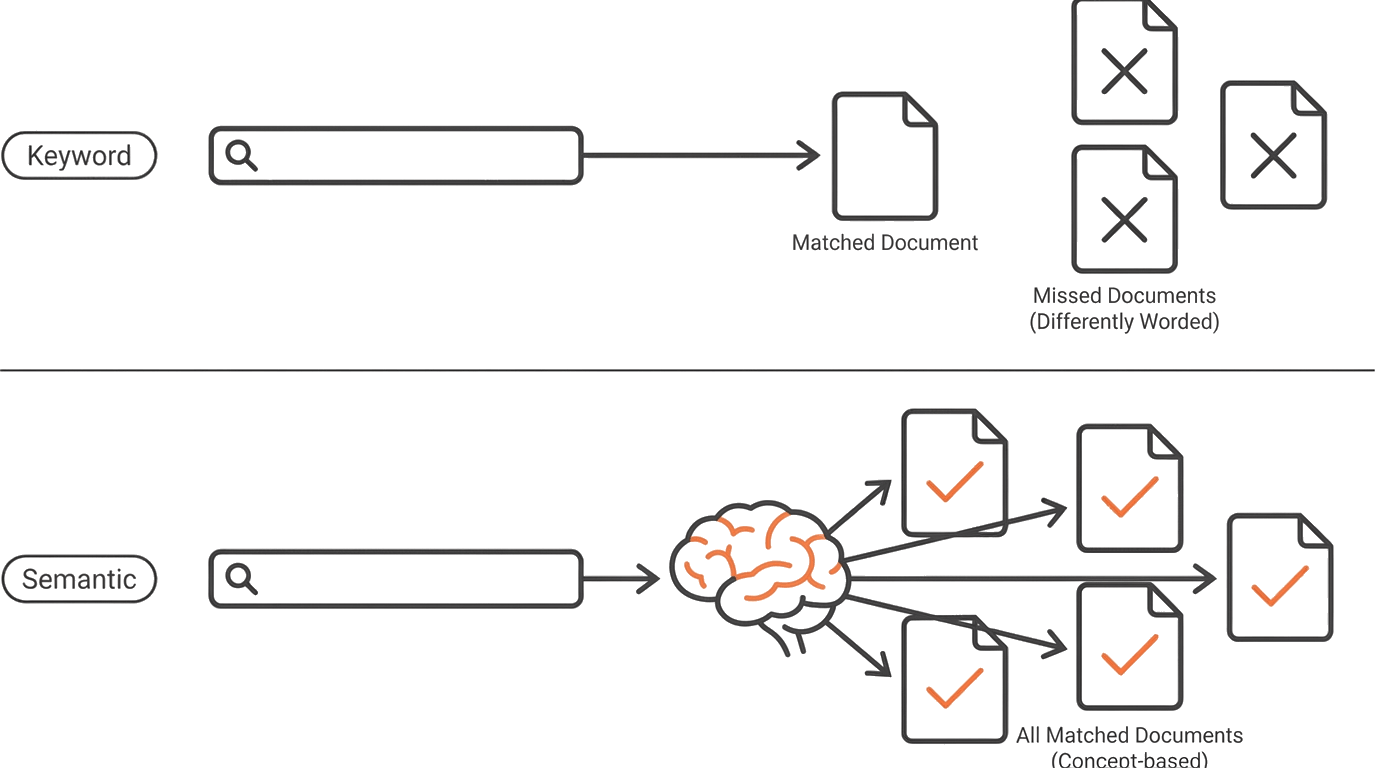
The trouble with keyword search is that one invention can be written up a dozen ways. A foldable phone screen might be filed as a “flexible display device,” a “bendable screen apparatus,” a “collapsible electronic display,” or a “hinged mobile terminal with deformable panel.” It might also be filed in Korean or Japanese. A keyword query for “foldable phone screen” misses all of those.
Every synonym you fail to anticipate becomes a gap in your search. The gap is widest exactly where it hurts most: in emerging fields where the terminology has not settled, and across languages where the same concept carries no shared vocabulary. You cannot write a Boolean query that predicts every variant a drafter might choose.
The scale of the problem is easy to underestimate. WIPO counted roughly 3.7 million patent applications filed worldwide in 2024 (WIPO World Intellectual Property Indicators 2025 ). Across that volume, drafters describe the same ideas in countless different ways, which means a keyword-only search routinely leaves relevant prior art on the table.
For the full keyword vs. semantic vs. classification breakdown, see Patent Search Strategies.
How semantic patent search works
From the searcher’s side, the flow is simple. You write a plain-language description of the technology, problem, or feature you care about. The AI matches it against patents by concept, regardless of the exact words any individual patent used. Results come back ranked by relevance, with the closest matches at the top.
A few things follow from working by meaning rather than by text:
- No Boolean logic or codes required. You describe the idea the way you would explain it to a colleague. There are no operators to learn and no classification taxonomy to navigate.
- Works in any language. You can write your query in any language, and the search matches on meaning, so it surfaces conceptually relevant patents, including ones originally filed in other languages. Each result appears in the language it was filed in.
- Rephrasing pays off. If the first pass misses, restating the query to emphasize a different mechanism, material, or purpose often pulls in patents the first wording did not reach.
For a hands-on, step-by-step walkthrough of running one, see the semantic search tutorial.
Semantic vs. keyword vs. classification, in brief
The short version of the comparison:
| Method | Matches on | Best for |
|---|---|---|
| Keyword | Exact text strings | Known, standardized terminology |
| Semantic | Meaning of a description | Discovery, cross-language, first pass |
| Classification | Formal CPC/IPC codes | Comprehensive coverage of a defined domain |
The point is that these methods complement each other. Semantic search is the fastest way into an unfamiliar area because it does not depend on knowing the vocabulary first. Once you see what comes back, you can pivot to keyword or classification search to tighten things up. For the full comparison, including strengths, weaknesses, and how to sequence the three, see Patent Search Strategies.
When to use semantic patent search
Reach for semantic search whenever you need to find relevant patents and do not yet know the exact terms to look for.
- Prior art and patentability. Before filing, describe your invention and see what already exists. Start with What Is Prior Art? for the concept, then the semantic search tutorial for the workflow.
- Freedom-to-operate screening. Describe a product you plan to ship and scan for patents that could be in the way. See Freedom-to-Operate Analysis.
- Landscape and white-space mapping. Describe a technology area to see who is active and where the gaps are. See Patent Landscape Analysis.
- Competitive monitoring. Describe a competitor’s known direction and surface filings that fit it, even when they avoid the obvious terms.
How to run a semantic patent search with GoVeda
There are two ways to run one, both backed by the same corpus, so the choice is about workflow rather than coverage.
You can write your query in any language, and the search matches on meaning, so it can surface conceptually relevant patents, including ones originally filed in other languages. In the web app, you can then open any patent translated into your own language.
- In the GoVeda web app. Type a plain-language description into the search bar in Search mode and review the ranked results. The semantic search tutorial covers it step by step.
- From an AI assistant via the MCP server. Connect the GoVeda MCP server to an assistant such as Claude or ChatGPT and ask in plain language. The assistant runs the search for you and works the results into your conversation. See Build an AI Patent Research Agent and Patent Search in Claude Code and Any MCP Client.
Tips for sharper semantic queries
A few habits make results noticeably better:
- Be specific. Name the mechanism, the materials, and the problem the invention solves. “Solid-state lithium battery with a ceramic separator for electric vehicles” beats “battery technology.”
- Describe purpose, not just the part. Explaining why a component exists often matches claim language better than describing what it is.
- Rephrase when results miss. Lean on a different aspect of the technology and run it again.
The semantic search tutorial goes deeper on query craft.
Frequently asked questions
Is semantic patent search better than keyword search? Neither is strictly better. They are complementary. Semantic search wins for discovery, synonym-heavy fields, and cross-language work, while keyword search wins when you already know the exact terms and need precise, reproducible matches. The strongest searches use both.
What languages can I search in? Any language. You can write the query in whatever language you think in. Semantic matching then surfaces conceptually relevant patents, including ones originally filed in other languages.
Does it replace a professional searcher? No. It is a research tool that helps you find relevant patents faster, not a substitute for professional judgment. It does not constitute legal advice. For filing, licensing, or litigation decisions, consult a qualified patent attorney or agent.
How many patents does it cover? GoVeda’s semantic search runs across 220 million+ patents spanning 108 jurisdictions, updated as new patents are published.
Is it free to try? GoVeda offers a free trial plus paid plans. See goveda.com for current details.
Disclaimer: This article is for general informational purposes only and does not constitute legal advice. Patent law varies by jurisdiction and changes over time. For decisions about your specific situation, consult a qualified patent attorney or agent. GoVeda makes no warranty as to the accuracy or completeness of the information presented.