You’ll need the GoVeda MCP server connected first. It takes about a minute. See Connect to Claude or ChatGPT to set it up. Once it’s connected, just ask your question; your assistant reaches for GoVeda on its own when a patent task needs it. New accounts get a 14-day free trial with 10,000 credits.
Which patents in a field did everyone else build on? Forward citations are the closest signal patents have to influence. Name a technology and your assistant finds the candidates, counts who cites each, and charts the leaders.
The prompt
Open a new chat and paste:
Find the most influential patents in solid-state battery technology. Run a semantic search for 15–20 candidate patents, look up the forward-citation count for each, then rank and chart the top 10 by forward citations in an artifact (horizontal bar). For each bar, give the publication number, assignee, and a one-line summary of what it covers.
Two steps spend credits here: the semantic search that gathers candidates (roughly 50–320 credits, the larger cost) and the forward-citation lookups (about one credit per patent, so ~15–20 in this example). Asking for fewer candidates trims the lookups but not the search, which sets the floor on cost.
What GoVeda does behind the scenes
Influence isn’t in the search ranking, so the assistant gathers candidates first and then measures each one:
Gather candidates
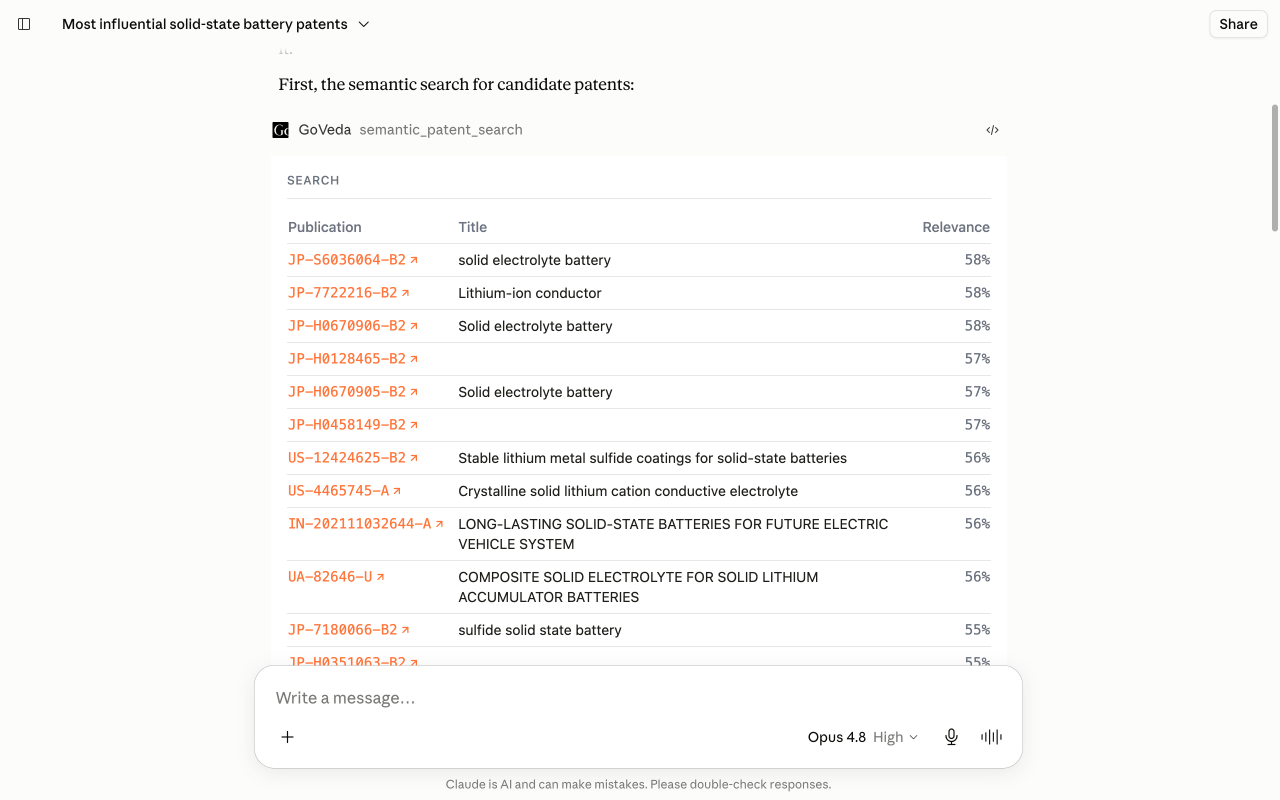
It runs semantic_patent_search on the technology to pull 15–20 candidate patents, a wide enough net that the genuinely influential ones are in the pool.
Count citations for each
It calls get_patent_forward_citations once per candidate to get the number of later patents citing it. This is the part that spends credits, which is why the candidate count is worth choosing deliberately.
Rank and chart
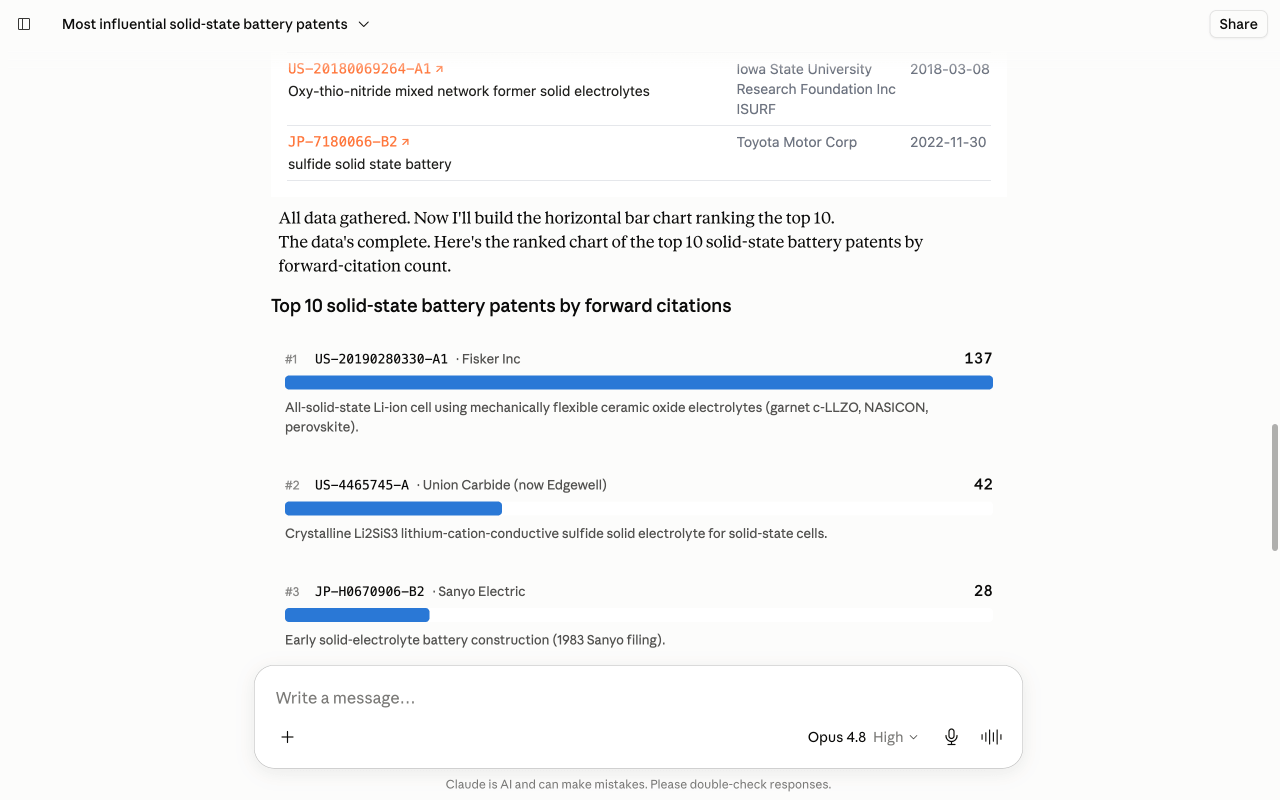
It sorts the candidates by forward-citation count, takes the top 10, and renders them as a horizontal bar chart in an artifact.
Label each bar
It pulls the publication number, assignee, and a one-line summary for each leader, so the chart reads as a ranked list rather than anonymous bars.
You can watch it search, count, and chart in the chat:
What you get
You get a horizontal bar chart of the 10 most-cited patents in the field, each labeled with its publication number, assignee, and a one-line summary. The assistant reads the count honestly. Forward citations measure influence and reward age (a foundational patent accumulates them for years), so they signal which patents others built on, not what any of them is worth.
Tips
Older patents have had longer to collect citations, so a recent breakthrough can rank low even when it matters. Narrow the search to a recent window if you want to surface newer influence. Widen the candidate pool for better coverage, knowing each extra candidate is another citation lookup. Swap in any technology.
Next: browse more use cases or read the MCP tool reference.