Put Your ChatGPT API Credits to Work on IP Research
Since October 28, 2026 , OpenAI has offered monthly API credits to ChatGPT Pro and Business subscribers. They are separate from your usage in ChatGPT, and anything you don’t spend expires at the end of the billing cycle.
GoVeda Agent can use those credits. Add an OpenAI API key from the organization that receives them, and every request GoVeda Agent sends to a GPT model is billed to your OpenAI account instead of your GoVeda credits. The searching and reading of IP data still runs on GoVeda.
What API credits come with ChatGPT plans?
As of November 6, 2026, OpenAI’s API credits for ChatGPT subscribers guide lists these amounts:
| ChatGPT plan | Monthly API credit |
|---|---|
| Pro, $100 tier | $100 |
| Pro, $200 tier | $200 |
| Pro, $500 tier | $500 |
| Business, Standard seat | $20 per paid seat |
| Business, Premium seat | $100 per paid seat |
Business credits are pooled and capped at $500 per workspace per month. A workspace that pays annually upfront gets the full year’s grant at once, capped at $6,000, and that grant expires at the end of the annual billing cycle.
Your subscription must be paid and at least seven days old before you can claim. Free, Go, Plus and Enterprise plans don’t include the credits, and neither do free trials or complimentary subscriptions. OpenAI describes this as a benefit that runs “while these benefits are available”, so check its guide for the current terms before you plan around a number.
You claim once. After that, credits arrive when your subscription renews. Your first grant is prorated for the time left in your current billing cycle.
Why spend them in GoVeda Agent?
- They expire anyway. Unused credits don’t roll over, so research you run with them uses a benefit that would otherwise lapse.
- GoVeda adds no fee. OpenAI bills the model requests at its own prices.
- They’re separate from your ChatGPT usage. The credits pay for API usage in an API organization, and OpenAI states they don’t increase your ChatGPT or signed-in Codex limits.
- IP tools still run on GoVeda. GoVeda Agent still searches global IP records, reads full text and checks legal status with GoVeda’s own tools.
How do you connect them?
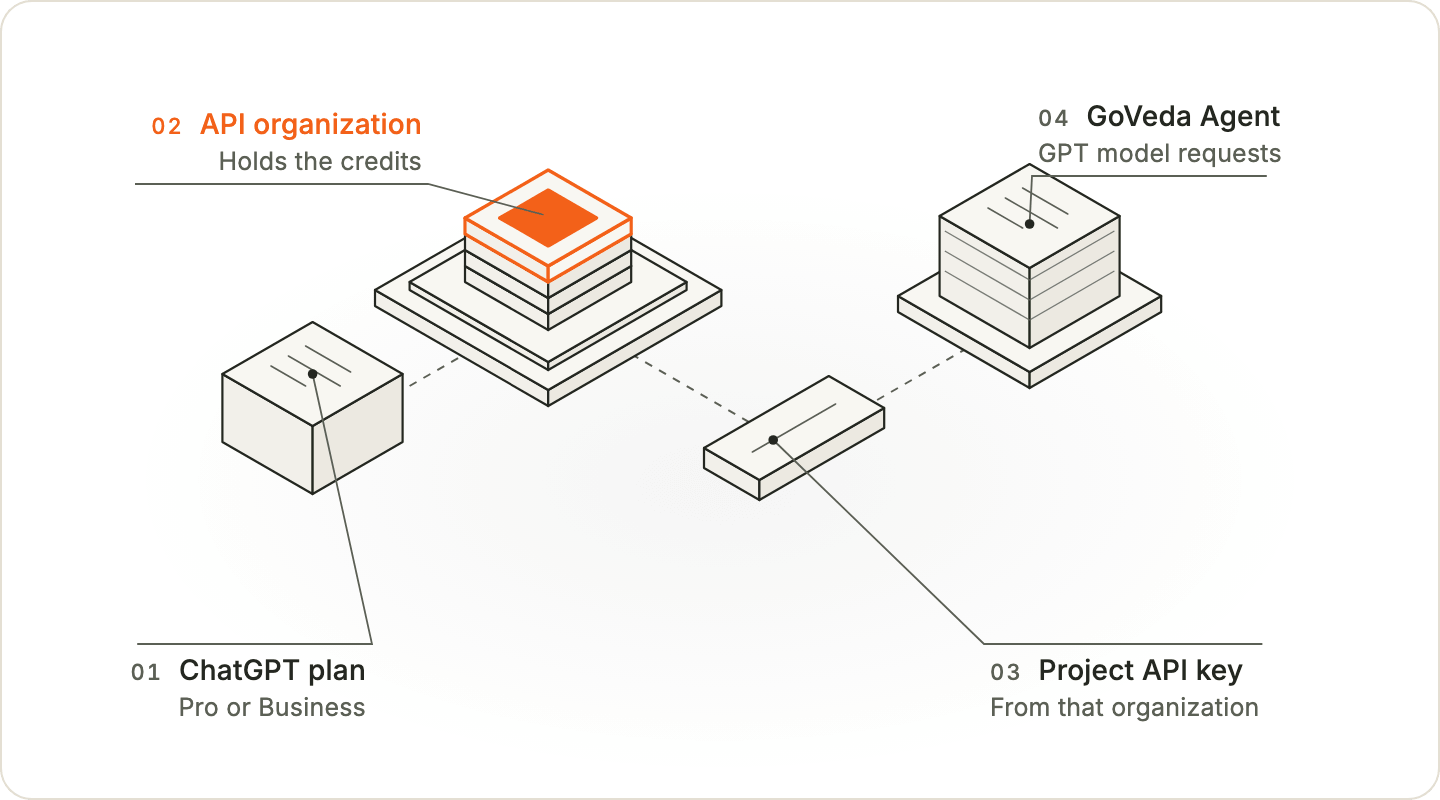
The credits land in one API organization, and only keys from that organization can spend them.
1. Claim the credits
Start from either side:
- From ChatGPT: on a Pro plan, open Settings > Billing . On a Business plan, open the workspace billing settings or the Admin Console . Find the API credits benefit and confirm the organization that will receive them.
- From the API Platform: sign in to the API Platform , select the organization, open Billing and select your eligible subscription or workspace.
You need to own both the subscription or workspace and the API organization, and your ChatGPT and API accounts must use the same email address. If you are new to the API, you can link your Personal API Organization. No payment method is required while you have active free credits.
Changing the linked organization later means contacting OpenAI support, so choose carefully.
2. Create a key for GoVeda
On the API Platform , create a project API key in the linked organization. We recommend a project used only for GoVeda, with a hard spend limit . A separate project keeps GoVeda from using up credits meant for your other work.
A ChatGPT sign-in won’t work here. GoVeda Agent needs an API key.
3. Add the key in GoVeda Agent
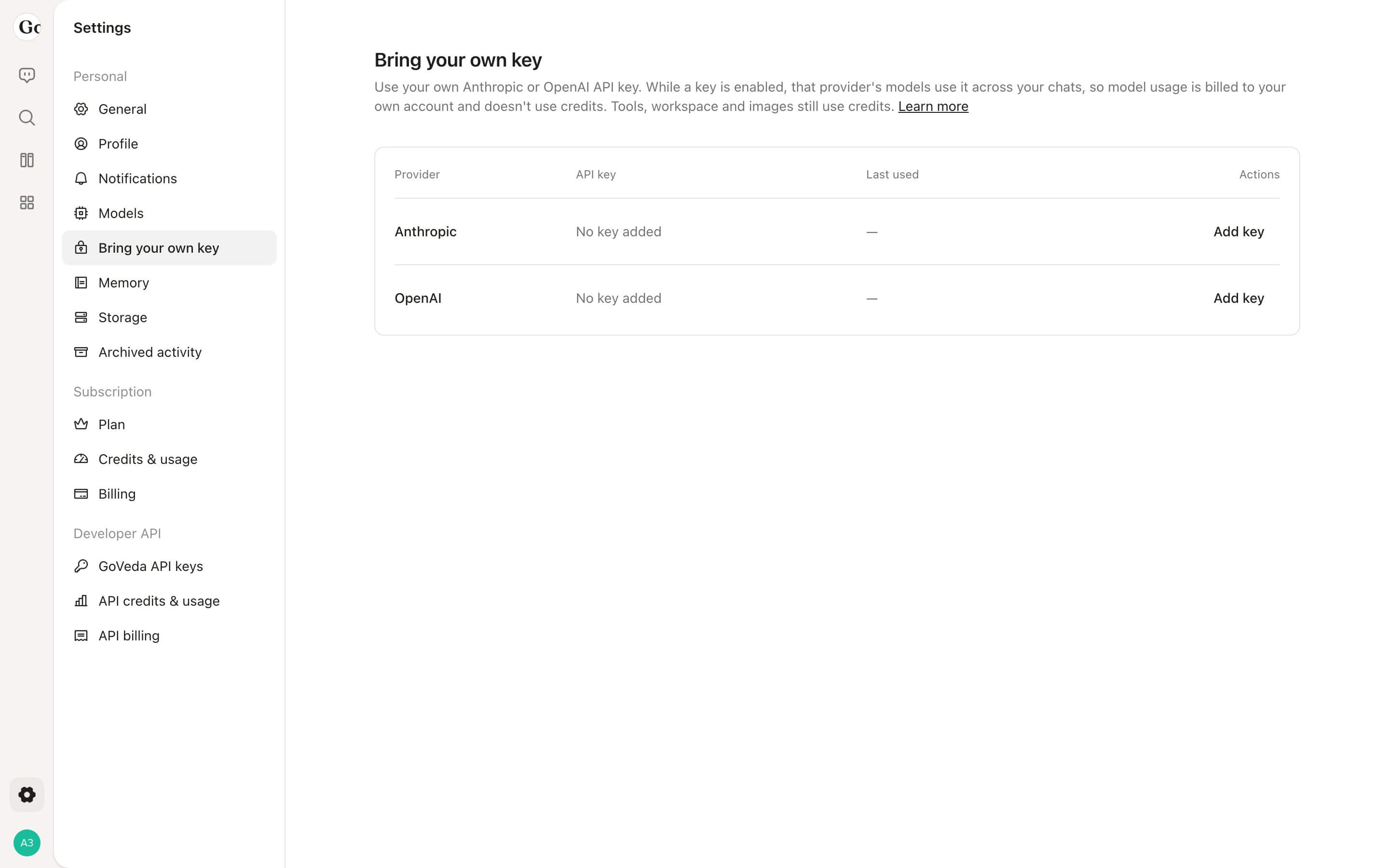
You need access to GoVeda Agent on your plan. Open Settings › Bring your own key, click Add key next to OpenAI, paste the key and click Validate and save. Validation sends one short request, which costs less than $0.01.
4. Choose a GPT model and start
Pick a GPT model your OpenAI organization has access to. From the next request on, the model work is billed to your key. There is no per-chat switch: while the key is enabled, all GPT requests use it.
What do the credits pay for, and what still uses GoVeda credits?
If the model is thinking or writing, your OpenAI account pays. If GoVeda is fetching, running or creating something for the model, GoVeda credits pay.
Paid from your OpenAI credits:
- The model reading your messages, files and tool results, and writing replies, plans and reports, in your chats
- Summarizing earlier parts of a long chat so it can continue
Paid from GoVeda credits:
- IP search, full text, legal status and other IP tools
- Web search and reading web pages
- Running code and working with files in your workspace
- Creating images
- Claude models, unless you also add an Anthropic key
For example, you ask a GPT model to find prior art for an invention. It runs four IP searches, reads ten IP documents and two web pages, then writes a summary. Your OpenAI credits cover the model reading the results and writing the summary. GoVeda deducts credits only for the searches and the reading.
Check what OpenAI charged on its usage dashboard . In GoVeda, Settings › Credits & usage marks the records where your key paid for the model.
What should you check before a long task?
Look at your organization’s limits page . OpenAI’s credits are subject to its API rate limits , and usage tiers rise with total credit purchases. Each tier also has a monthly usage limit ($100 on Free, $500 on Build), separate from any spend limit you set. OpenAI doesn’t say whether included credits count toward a tier, so an organization that has never bought API credits may hit lower limits than its credit suggests.
GoVeda retries brief rate limits automatically. If a limit holds, the chat pauses and keeps its progress until you fix it.
Keep a GoVeda credit balance too. Most IP research uses IP search and reading, and those tools need a balance even when your key pays for the model. GoVeda also stops a single task if its model usage becomes unusually large; send another message to continue.
What happens when the credits run out?
OpenAI spends free credits before any credits you bought. If you have purchased credits, usage continues on them. Once no credits remain, OpenAI rejects requests until your next grant arrives, unless you add paid credits or set up Auto Recharge.
GoVeda Agent never switches to your GoVeda credits on its own. The chat pauses with Your API key has reached its usage limit. Add funds or raise the limit with OpenAI, or disable the key in GoVeda to go back to credits, then click Retry in the chat. A spend limit stops a chat the same way when it is reached.
To keep a month’s credits from running out early, set the project’s spend limit below your monthly credit, and watch the usage dashboard in your first month: spend limits can overshoot slightly, and OpenAI doesn’t say how free credits count toward them.
Frequently asked questions
Does using the API credits reduce my usage in ChatGPT?
No. Your chats in GoVeda Agent are billed to the linked API organization, not to your ChatGPT plan.
I’m on ChatGPT Plus. Can I still use my own key?
Yes. Plus doesn’t include API credits, but you can add any OpenAI API key from an account with billing set up, and OpenAI bills its usage to that account.
Can my whole team use our Business plan’s credits?
Each person adds a key to their own GoVeda account; keys aren’t shared through GoVeda. If everyone creates a key in the linked organization, they all draw on the same pooled credit, so set a spend limit on the project.
What does OpenAI keep from these requests?
That depends on your own OpenAI account, because GoVeda’s agreements with providers don’t cover requests sent with your key. OpenAI states that API data isn’t used for training unless you opt in, and that abuse monitoring logs, which can include prompts and responses, are kept for up to 30 days by default, or longer where the law requires it or to prevent harm. Where a provider supports it, GoVeda asks it not to store responses. Check this against your confidentiality rules before you put unpublished inventions in a chat.
Is my key safe with GoVeda?
Your key is encrypted in your browser before it is sent and stays encrypted while stored. Only a separate, network-isolated service can decrypt it, and only to send a request to OpenAI. The AI and its tools never have it. See how your key is protected.
Can I use the same key for Codex?
Not on these credits. OpenAI states that Codex usage through API keys isn’t supported by this benefit.
Where can I find the full details?
Bring Your Own Key (BYOK) covers supported providers, every error message and data retention. On a Claude plan instead? See Put Your Claude Max API Credits to Work on IP Research.
This article is general information, not legal advice. For decisions on a specific matter, consult a qualified patent attorney or agent.
ChatGPT and OpenAI are trademarks of OpenAI, and Claude is a trademark of Anthropic, PBC. Credit amounts and eligibility are OpenAI’s and can change; check OpenAI’s guide for the current terms.