Novelty Assessment
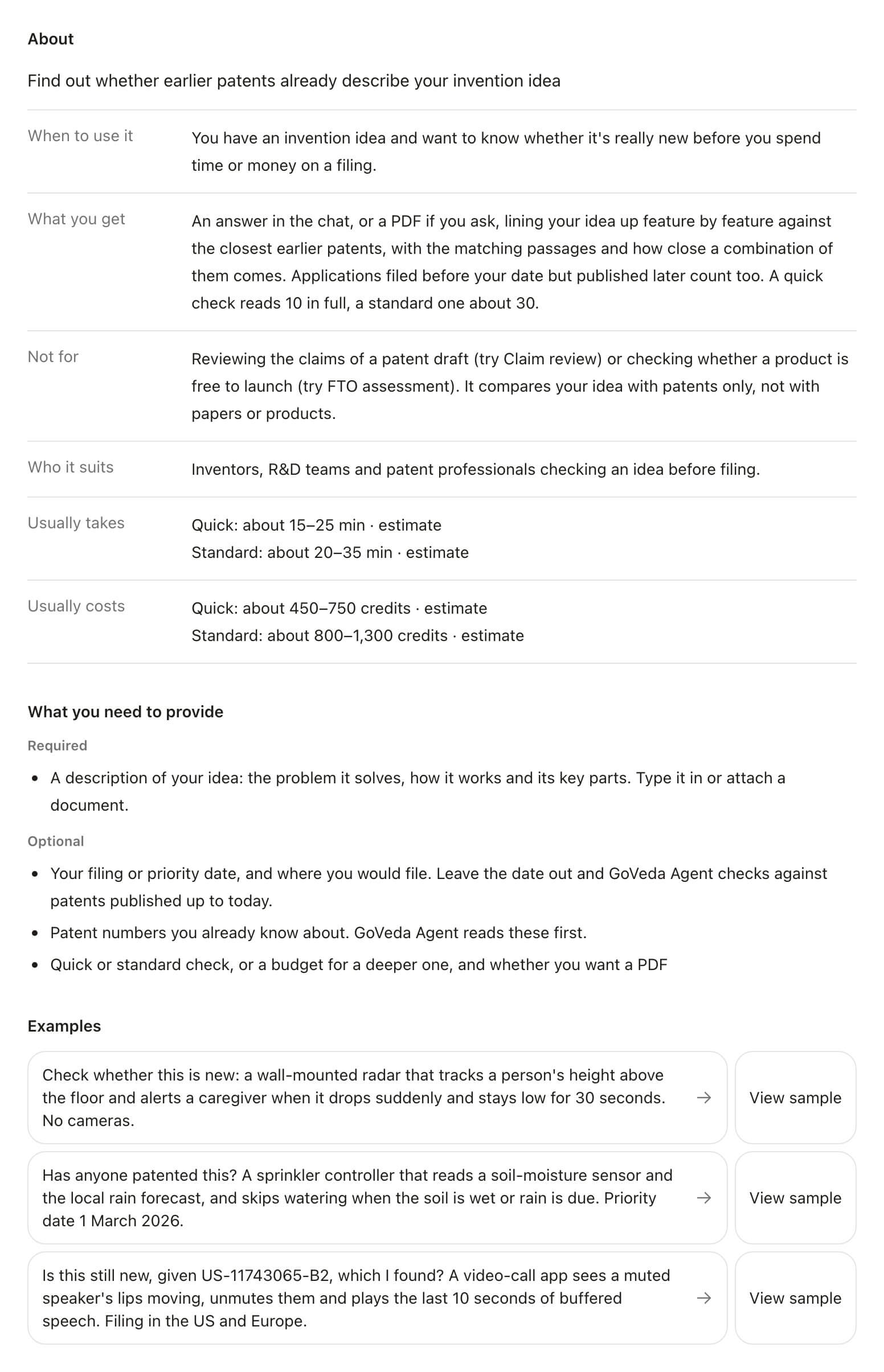
Novelty assessment checks whether earlier patents already describe your invention idea, so you can decide whether it’s worth a filing before you spend time or money on one. It is one of GoVeda’s own skills, listed under GoVeda in Capabilities.
- Depth: Quick reads the 10 closest patents in full · Standard screens every patent found on its abstract and claims and reads about 30 of the closest in full
- Usually takes: Quick about 15–25 min · Standard about 20–35 min
- Usually costs: Quick about 450–750 credits · Standard about 800–1,300 credits
- Output: An answer in the chat, or a PDF if you ask
- Start it: Capabilities › Novelty assessment › Start, or type
/in a chat
When to use it
It suits inventors, R&D teams and patent professionals checking an idea before filing.
Not for: Reviewing the claims of a patent application, or checking whether a product is free to launch (try FTO Assessment). To look for earlier material against someone else’s patent, try Invalidity Search.
What you need to provide
Required
- A description of your idea: the problem it solves, how it works and its key parts. Type it in or attach a document. A goal or a benefit alone is not enough, so GoVeda Agent asks how the idea works.
Optional
- Your filing or priority date. Leave it out and GoVeda Agent checks against patents published up to today.
- The offices where you would file, such as Europe, the US or China. They decide how applications filed before your date and published after it count.
- Patent numbers you already know about. GoVeda Agent always reads these in full.
- Who the result is for and what you will decide, for example an inventor deciding whether to file. GoVeda Agent fits the next steps to that decision.
- Quick or Standard, and whether you want a PDF.
Before it searches, GoVeda Agent breaks your idea into features, marks each one essential or optional, and asks you to correct the list. It asks this, and anything else that is missing, in a card titled A question from GoVeda Agent. For depth and budgets, see Quick or Standard.
What you get
The answer lines your idea up feature by feature against the closest earlier patents, quotes the matching passages and says what combining them rests on. It includes:
- Two short conclusions: whether any single earlier document describes every feature, and how high the inventive-step risk is (high, medium or low), with the strongest combination of documents and what it rests on. Either can be undetermined when a search failed, documents could not be assessed or a deciding feature is unclear.
- A table of your features against the closest documents, each marked disclosed, partly disclosed, not disclosed or unclear.
- The matching passages with their locations, translated when a document is not in your language.
- The dates that matter. Applications filed before your date and published later count too, and the answer says in which offices.
- The points that look new, and the features you should describe in more detail.
- Next steps for your decision. The answer shows which findings support each option; it does not tell you whether to file.
- What was covered: the depth, the searches, the patents read in full and what was not checked. In Standard, a patent ranked lower in screening is not read in full, so a disclosure only in its description can be missed.
Example requests
Check whether this is new: a wall-mounted radar that tracks a person's height above the floor and alerts a caregiver when it drops suddenly and stays low for 30 seconds. No cameras.Has anyone patented this? A sprinkler controller that reads a soil-moisture sensor and the local rain forecast, and skips watering when the soil is wet or rain is due. Priority date 1 March 2026.Before you rely on it
This is a technical comparison against the documents found, not a legal opinion. A search can miss documents, so finding no matching document does not prove that your idea is new. The method searches patents only, not papers or other non-patent literature, and applications filed in the last 18 months may not be published yet. Have a patent attorney review the result before you file.
Related
- FTO Assessment: try it when the question is whether others’ patents could block your product, not whether your idea is new.
- Invalidity Search: try it when you want to know whether someone else’s patent holds up, not whether your own idea is new.
- Patent Landscape: try it when you want to see how a whole field looks, not whether one idea is new.
- Your Own Skills: save your own variant, for example with your disclosure questions and report format.