This is a live patent deal dashboard we built in Claude. It follows the patent assignments, pledges and licenses recorded in semiconductor memory, and every number comes from a query to the GoVeda patent database that runs again each time the dashboard opens.
Investment, M&A and business development teams watch which patents in their sector change owner, and which are pledged as collateral. The records are public, but they sit in different places: the US assignment register for American patents, and legal event notices at CNIPA, the EPO and other offices. Pulling them together for one technology area is slow, and the result is out of date as soon as a new assignment is recorded.
Claude Dashboards , in beta on paid Claude plans since October 2026, work with your connectors. A dashboard built on GoVeda Patent keeps its queries, so it shows the current records every time someone with GoVeda connected opens it. This post walks through what our memory example shows, what assignment records can and cannot tell you, how to build your own with one prompt, and what it costs to run.
What does a patent deal flow dashboard show?
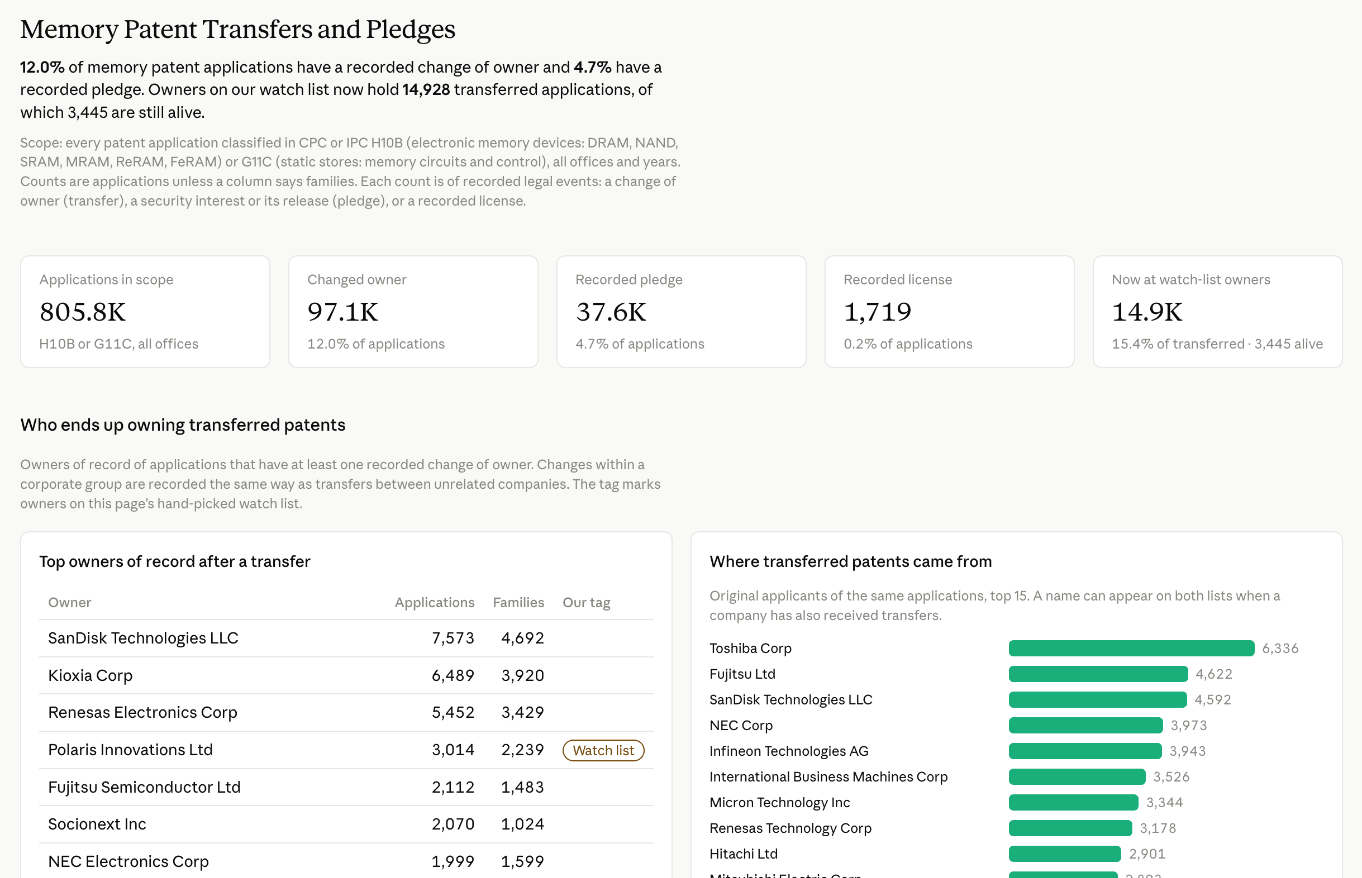
Our example covers every patent application classified in CPC or IPC H10B (memory devices such as DRAM, NAND flash, SRAM and MRAM) or G11C (memory circuits and their control), across all offices and years. That is 805,796 applications. Each part of the dashboard answers one question.
| Part | Question it answers |
|---|---|
| Headline counts | How many applications have a recorded transfer, pledge or license, and what share of the field is that? |
| Top owners after a transfer | Which companies own the most patents that changed hands? |
| Where transferred patents came from | Which original applicants are the biggest sources? |
| Owners on a watch list | How many transferred patents does each owner you follow hold, and how many are still alive? |
| Transfers on recently granted patents | Who assigned what to whom, on which dates? |
| Turnover by filing year | What share of each filing year’s patents has changed hands since? |
| Records by office | Which patent offices publish these records, and how many? |
Clicking an owner in the watch-list table loads the transfers on that owner’s most recently granted patents into the list below it.
What does the memory patent data show?
The figures below are what the dashboard showed on October 21, 2026. They count applications, so a patent filed in several countries counts once per filing.
How many memory patents have changed hands?
In total, 97,080 applications (12.0%) have at least one recorded change of owner. 37,570 (4.7%) carry a recorded pledge or security interest, and 1,719 (0.2%) a recorded license. Most licenses are never recorded, so the license count is a floor rather than a measure of licensing activity.
Who owns the transferred patents now?
The largest owners of record of transferred memory patents are SanDisk Technologies (7,573 applications), Kioxia (6,489) and Renesas Electronics (5,452), followed by Polaris Innovations (3,014), Fujitsu Semiconductor (2,112) and Socionext (2,070). On the other side, the original applicants with the most transferred applications are Toshiba (6,336), Fujitsu (4,622), SanDisk Technologies (4,592), NEC (3,973) and Infineon Technologies (3,943).
The two lists overlap. SanDisk Technologies appears in both, because it has recorded transfers in and out. Changes of owner within a corporate group, such as reorganizations and name changes, are recorded the same way as transfers between unrelated companies. The dashboard shows recorded owners only. It does not say why a transfer took place.
How many transferred patents do the owners you follow hold?
The dashboard has a watch list: 32 owner names we picked by hand, shown as 18 rows, some of which combine several owner names. Combining names in one row is our choice for this example and does not reflect any recorded relationship between them. For this example we picked owners because they hold transferred patents first filed by chipmakers. Together they hold 14,928 transferred memory applications (an application held by two listed names counts once, so the rows add up to slightly more), and 3,445 of those are alive today, meaning pending, or granted and still in force.
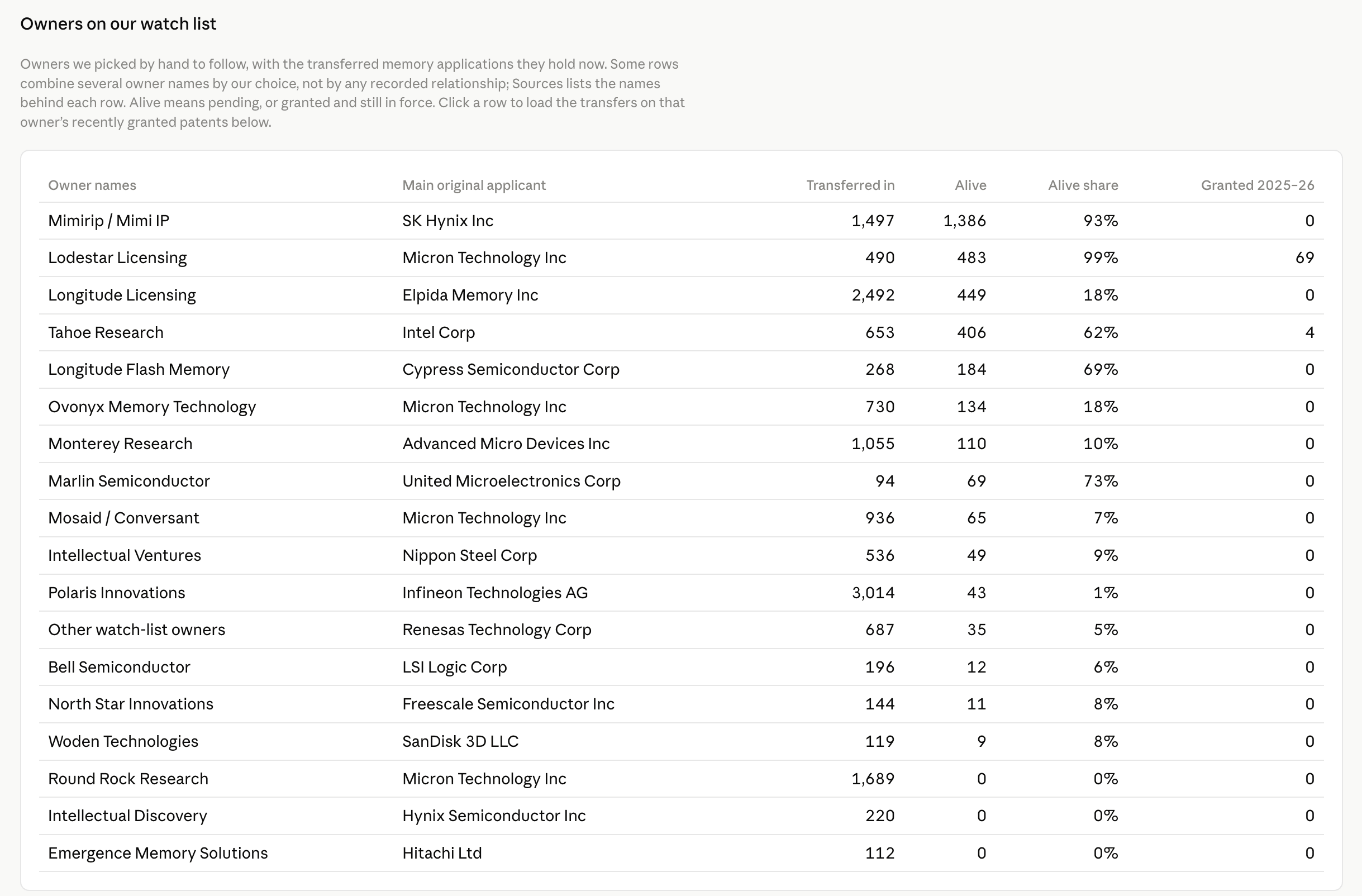
The table separates portfolios that are still in force from ones that are mostly no longer alive (expired, lapsed or abandoned):
- The row that combines the owner names Mimirip LLC and Mimi IP Co Ltd holds 1,497 transferred applications, 1,386 of them alive. The most common original applicant of these patents is SK Hynix.
- Lodestar Licensing Group holds 490, of which 483 are alive. Most were filed by Micron Technology, and 69 were granted in 2025 or 2026.
- Tahoe Research holds 653, of which 406 are alive, mostly filed by Intel.
- Polaris Innovations holds 3,014, of which 43 are alive. Round Rock Research holds 1,689, none of them alive.
The watch list is ours. Ask Claude to add or remove owners to match what you follow.
What do the transfers on recently granted patents show?
The record list shows the 25 most recently granted applications held by the watch-list owners, each with its latest recorded change of owner. On October 21, 2026, 21 of those 25 records showed an assignment from Micron Technology to Lodestar Licensing Group. Their execution dates run from March 23, 2023 to May 2, 2025, and the US recordings were filed between August 24, 2023 and December 5, 2025. Two records show an assignment from Intel to Tahoe Research dated October 24, 2022, and two EPO records for Lodestar Licensing Group name the new owner without the previous one. For those two, the date shown is the EPO’s registration date, because the record gives no execution date.
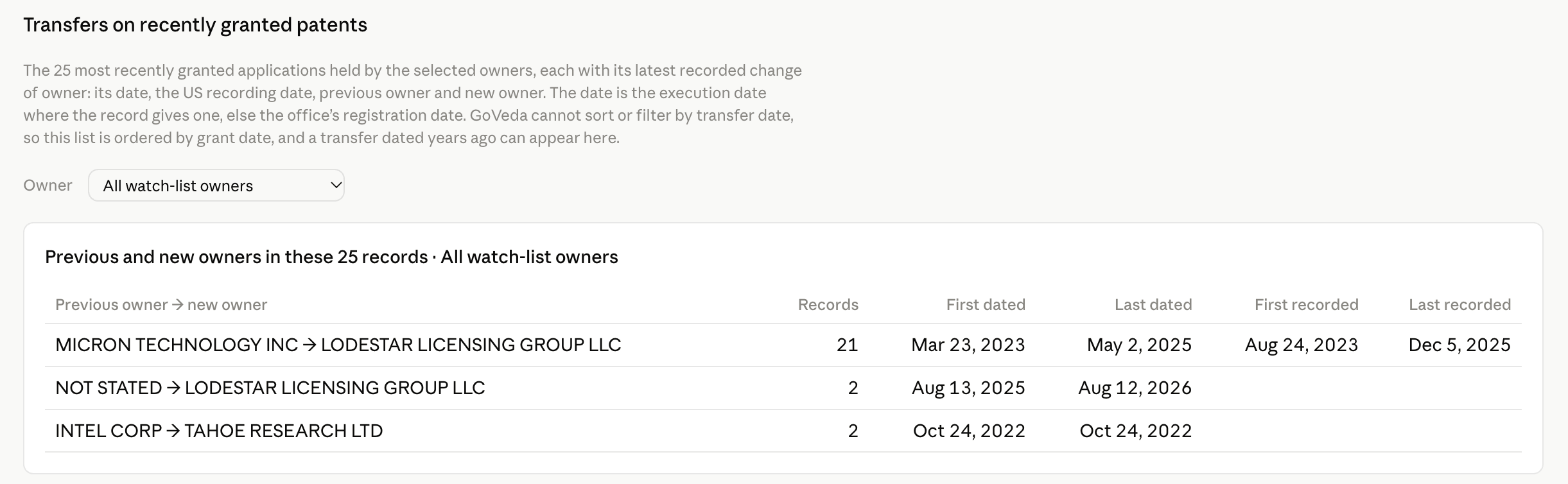
Of the 21 Micron records, 19 share one execution date, March 23, 2023, and their US recordings carry different dates. So one execution date can appear on many records recorded at different times.
Which offices hold the records?
The US register holds most of what the dashboard can see. 25.2% of US memory applications have a recorded transfer and 15.0% a recorded pledge. The transfer share is 16.9% for German applications, 9.4% at the EPO, 8.9% in China, 8.2% in Japan and 5.1% in Korea. Pledges outside the US are rare in the data: 255 in China, 105 in Korea and none at the other offices shown. A low share at an office can mean thin published records as much as fewer transfers.
How does turnover change with the filing year?
Older patents have had more time to change owner. 24.7% of the memory applications filed in 2002 have since changed owner, compared with 13.6% of those filed in 2015 and 3.2% of those filed in 2022. The pledged share peaks for filings from 2012, at 9.7%. The dashboard plots these shares by filing year; the most recent years are incomplete because applications publish about 18 months after their earliest filing or priority date.
What can assignment records tell you?
In the US, 35 U.S.C. 261 makes recording the way to protect an assignment: an unrecorded assignment is void against a later purchaser or mortgagee for a valuable consideration without notice, unless it is recorded within three months of its date or before that later purchase or mortgage (MPEP 301 ). Recording later than that does not by itself make an assignment invalid; the rule protects a later purchaser or mortgagee who paid value without notice. The USPTO also records license agreements and security agreements so that others have notice of them, and recording is not a determination of the document’s effect on title (MPEP 313 ).
That shapes how to read the dashboard:
- A record is a registered fact. It says who assigned rights to whom and when the paperwork was executed and recorded. It does not say what was paid or why.
- Pledge counts include releases. A security agreement and its later release are both pledge records, and releases are not always recorded, so a pledge record does not show whether a lien remains.
- Not every transfer is a sale. Group reorganizations, mergers, name changes and some late-recorded assignments from inventors to their employer are recorded as changes of owner too.
- Transfer dates are on each record, not in the filters. GoVeda returns the execution and recording dates in each patent’s transfer history, but it cannot filter or sort a whole field by transfer date. That is why the record list is ordered by grant date.
- The secured lender is not counted. Lenders are named in the pledge records themselves, but the statistics count patents by their owner of record.
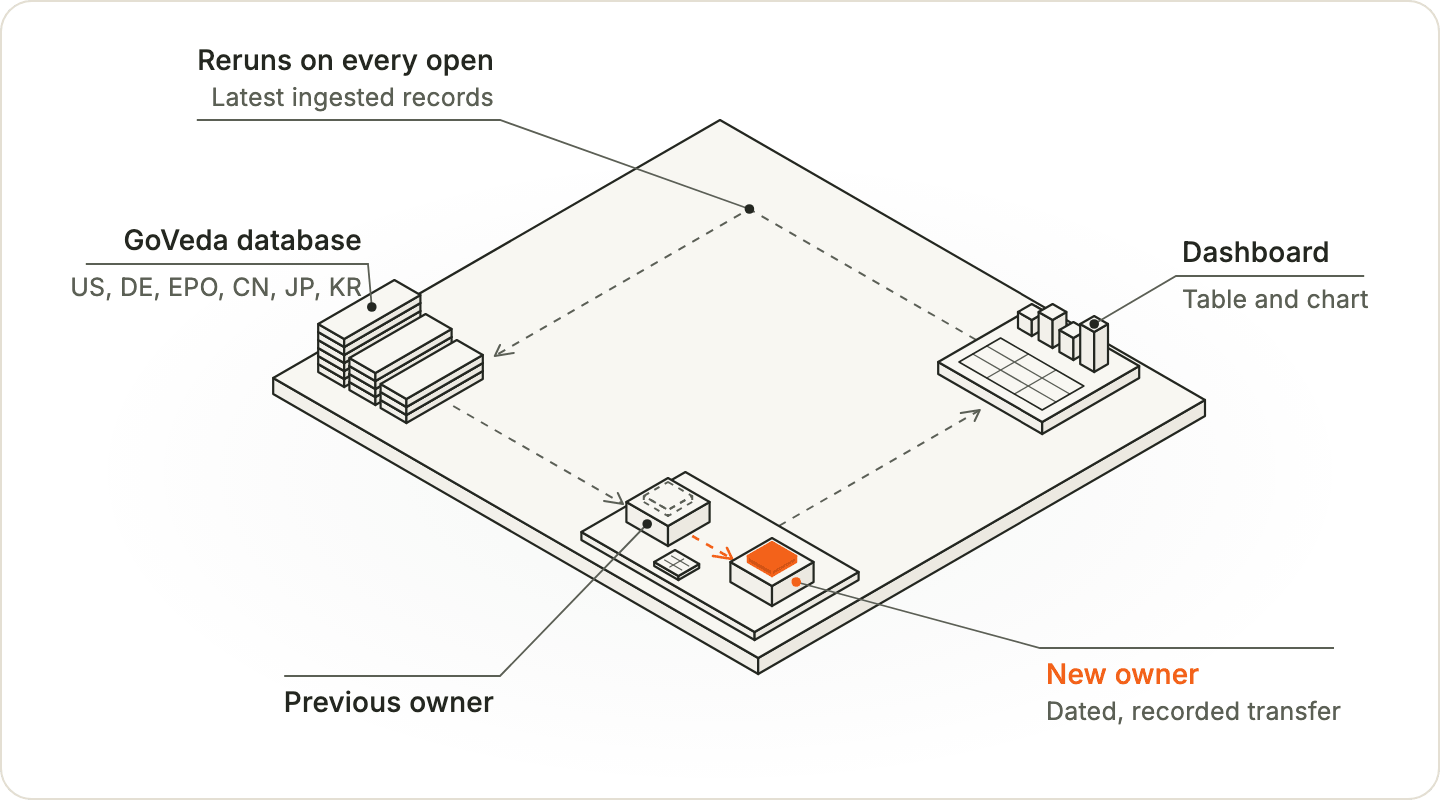
How is a live dashboard different from a one-off page?
If you ask Claude for a chart of patent transfers, Claude may build a one-off page rather than a live dashboard: it runs the queries once, writes the results into the page and hands it over. A live dashboard keeps the queries, so it goes back to the patent database whenever you open it.
| One-off page | Live dashboard | |
|---|---|---|
| Data | A snapshot from the day it was made | The latest data in the GoVeda database every time you open it |
| New assignments and pledges | Missing until you ask Claude to rebuild the page | New recordings are reflected in the counts once GoVeda ingests them |
| Owners of record | The owners as of the day the page was made | The latest recorded owner and transfer in the database each time you open it |
| Filters | Limited to the data already in the page | Each filter, such as picking an owner from the watch list, re-queries the GoVeda database within the dashboard’s scope |
| Trust | Figures on their own | Every figure links to the query behind it, and the rows that query returned can be downloaded as CSV |
| Upkeep | Rebuild and re-check for each update | Build once and reuse it; adjust the watch list when you need to |
| Team use | Everyone works from the same old copy | Each colleague sees current records through their own GoVeda connection |
A one-off page is fine for a snapshot you want to keep as it is, such as the figures for a report on a given date. For records you follow over time, the dashboard does the rebuilding for you.
How do you build one in Claude?
Connect GoVeda Patent
Add GoVeda Patent from Claude’s connector directory and sign in once. Using GoVeda Patent Inside Claude shows each step.
Paste this prompt
Copy the prompt into a new Claude chat:
I want to build a dashboard in Claude that tracks patent deals in a
technology area: assignments, pledges (security interests) and recorded
licenses, using GoVeda Patent data.

Before you build anything, help me set the scope:
- Ask which technology area I want to watch, then suggest CPC or IPC
  codes for it and show me what each code covers.
- Ask which kinds of new owners I care about, such as patent licensing
  companies, spin-offs or acquirers, and whether there are companies
  I already want flagged.
- Use GoVeda to find the largest current owners of transferred patents
  in the area, and look up the owner names for each company you flag,
  including subsidiaries and group companies.
- Ask which patent offices and which filing years matter to me.
Show me the proposed codes, companies and filters, and wait for my
confirmation.

The dashboard should show:
- how many applications have a recorded transfer, pledge or license,
  and the share of the area for each
- the largest current owners after a transfer, with the companies I
  flagged marked, and the original applicants those patents came from
- for each flagged company: patents held, how many are still alive,
  and the main original applicant
- a list of the most recently granted patents of a company I pick,
  with execution date, recording date, previous owner and new owner
- the share of each filing year that has changed hands, and the
  records by patent office

Keep the data live, so the dashboard runs its queries each time I
open it. Keep the record list to 25 patents, and tell me what each
open will cost in credits.
Claude starts by agreeing on the scope with you: the technology area, the classification codes, which owners to flag and which offices count. After that, ask for changes in the same chat, such as another company to flag, a chart or a narrower date range.
The dashboard keeps its queries rather than a copy of the numbers, so you do not need to rebuild it to see new records. Build a Competitor Patent Monitoring Dashboard in Claude shows the same approach for following competitors’ filings.
What does it cost to keep running?
Each time the example dashboard opens or refreshes, it runs five queries:
| Query | Credits |
|---|---|
| Four statistics calls (overview, owners after a transfer, pledges, licenses) at 2 credits each | 8 |
| One list page of 25 patents | 2 |
| Transfer history for each of the 25 patents, 1 credit each | 25 |
| Total | 35 |
Changing a filter reruns the query behind it: picking another watch-list owner reruns only the record list, about 27 credits, because that list includes each patent’s transfer history. Looking up classification codes and owner names is free. The transfer history is not part of the default patent record, so each patent that returns one adds 1 credit. A shorter list costs less. The MCP pricing page lists every tool’s price.
Every viewer runs the queries with their own GoVeda account. A colleague who opens a shared copy needs GoVeda connected in Claude to see the data, and their opens use their own credits.
Frequently asked questions
Where do patent assignment records come from?
Patent offices publish them. In the US, a party to an assignment, security agreement or license can record it with the USPTO, which keeps a public register. Other offices, such as CNIPA, the EPO and the German office, publish changes of owner as legal events on the patent’s record. GoVeda gathers both into one transfer history per application.
Can the dashboard show what a patent deal was worth?
No. Assignment records name the parties and the dates, but they do not state a price, and the dashboard does not infer one. Treat each record as a registered fact about ownership, not as evidence of a deal’s value or purpose.
Does a pledge record mean the patent is still collateral today?
Not necessarily. A pledge record can be the security agreement or its later release, and the dashboard counts both. Releases are not always recorded, and in the US a security interest also depends on filings outside the patent office, so a patent office record alone does not establish whether a lien remains.
How is a live dashboard different from a page Claude generates once?
A one-off page is a snapshot of the records on the day Claude made it. A live dashboard stores the queries instead, so it shows the latest data in the GoVeda database each time it opens, new recordings are reflected in its counts once GoVeda ingests them, its filters re-query the database within the dashboard’s scope, and every figure links to the query behind it.
How many credits does the example dashboard use?
About 35 credits each time it opens: four statistics calls at 2 credits each, and one list of 25 patents with their transfer histories, which costs 2 credits for the page and 1 credit for each patent’s history.
This article is general information, not legal advice. For decisions on a specific matter, consult a qualified patent attorney or agent.