FTO Assessment
FTO assessment checks which patents in the countries where you will make, sell, use or import a product could stand in its way, so you can prepare a launch or market entry. It is one of GoVeda’s own skills, listed under GoVeda in Capabilities.
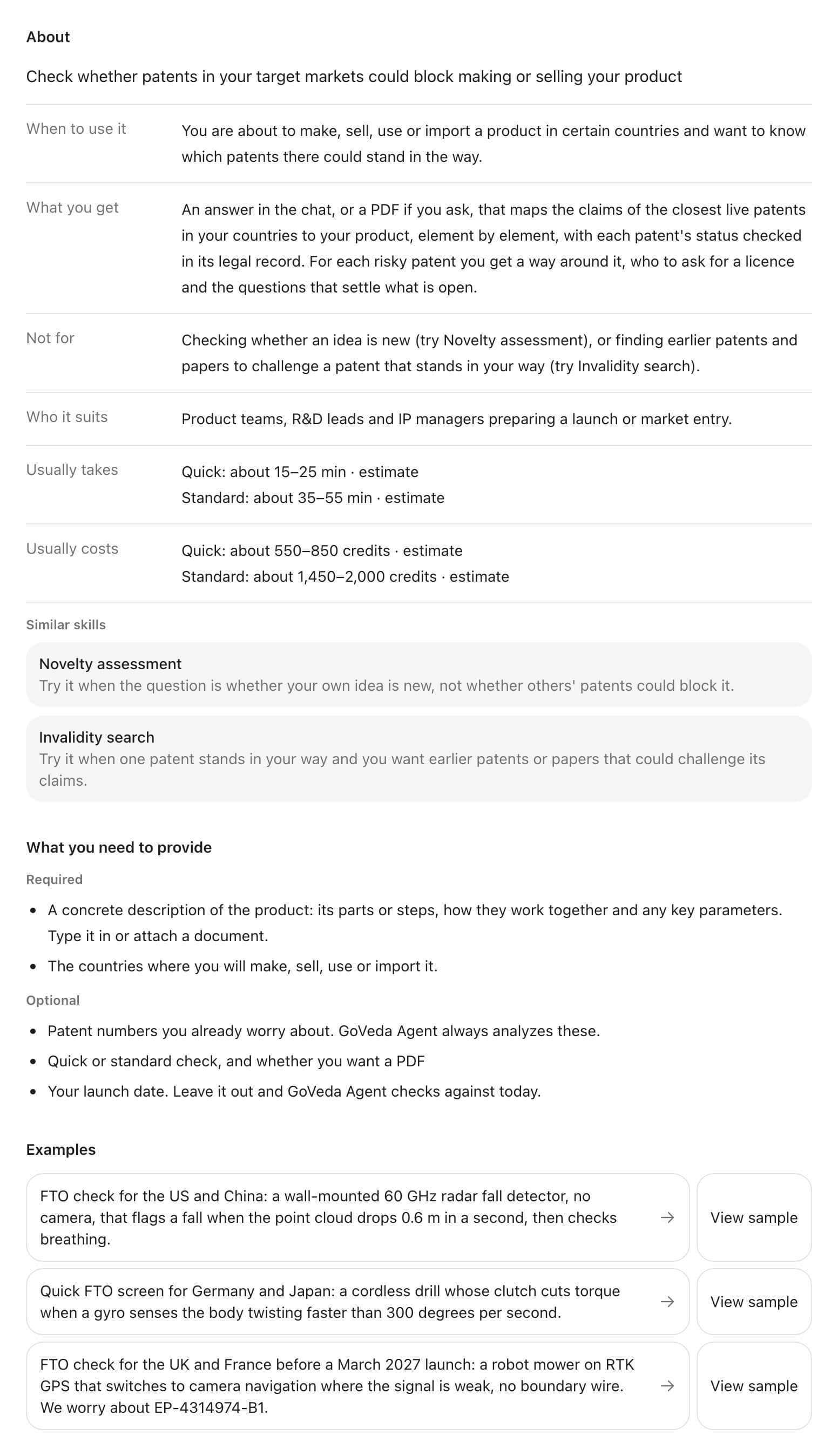
- Depth: Quick maps the claims of the 10 closest live patents to your product · Standard maps 50
- Usually takes: Quick about 15–25 min · Standard about 35–55 min
- Usually costs: Quick about 550–850 credits · Standard about 1,450–2,000 credits
- Output: An answer in the chat, or a PDF if you ask
- Start it: Capabilities › FTO assessment › Start, or type
/in a chat
Both depths search patents and utility models that are in force or pending in your countries, including European patents for European countries. Standard is the most it maps; with a larger budget, GoVeda Agent offers the next patent families as a next step, at about 30 credits a family.
When to use it
It suits product teams, R&D leads and IP managers preparing a launch or market entry.
Not for: Checking whether an idea is new (try Novelty Assessment), or judging whether a patent is valid. To look for earlier material that could support a challenge to a patent, try Invalidity Search.
What you need to provide
Required
- A concrete description of the product: its parts or steps, how they work together and any key parameters. Type it in or attach a document. A goal, a benefit or a marketing description is not enough, so GoVeda Agent asks for concrete technical features.
- The countries where you will make, sell, use or import it. Patent rights are territorial, so GoVeda Agent asks for the countries if they are missing. It never searches worldwide instead.
Optional
- Patent numbers you already worry about. GoVeda Agent always analyzes these.
- Your launch date. Leave it out and GoVeda Agent checks against today.
- Quick or Standard, and whether you want a PDF.
Before it searches, GoVeda Agent breaks the product into features, marks the ones most likely to be claimed, and asks you to correct the list. It asks this, and anything else that is missing, in a card titled A question from GoVeda Agent. If you don’t know a detail, say so. GoVeda Agent lists it as an open question rather than filling it in. For depth and budgets, see Quick or Standard.
What you get
The answer maps the claims of the closest live patents in each country to your product, element by element, with each patent’s status checked in its legal record. It includes:
- A conclusion for each country: high, medium or low screening risk, or undetermined, naming the patents that drive it. Undetermined means your description lacks the details that decide it.
- For each high-risk, medium-risk or undetermined patent: the owner of record, its status with dated evidence, its expiry and the full claim mapping, with each element marked met, not met or unclear.
- The product details to supply, grouped by feature, with the patents each one would settle. Answer them in the chat and GoVeda Agent checks those patents again and says which ratings changed.
- Pending applications as a separate watch list, not a current risk.
- For each risky patent: a way around it, who to ask for a licence, the questions that settle what is open, and the earlier documents cited against it in examination as a place to start a validity check.
- Next steps, and what was covered: countries, analysis date, depth, patents analyzed and what was not checked, such as design patents and applications not yet published.
Example requests
FTO check for the US and China: a wall-mounted 60 GHz radar fall detector, no camera, that flags a fall when the point cloud drops 0.6 m in a second, then checks breathing.Quick FTO screen for Germany and Japan: a cordless drill whose clutch cuts torque when a gyro senses the body twisting faster than 300 degrees per second.Before you rely on it
This is a screening of the patents found, not a legal opinion or a clearance. It cannot guarantee freedom to operate. Patent rights are territorial, statuses change, and applications filed in the last 18 months may not be published yet. Confirm status and claims with the official register, and have a patent attorney review the result before launch.
For a US patent, a PTAB review or a reexamination certificate may have cancelled or amended claims. The available data may not show which claims survive, even when the patent appears active. Check the certificate before relying on the claim comparison.
Related
- Novelty Assessment: try it when the question is whether your own idea is new, not whether others’ patents could block it.
- Invalidity Search: try it when a patent stands in your way and you want earlier material that could support a challenge to its claims.
- State-of-the-Art Review: try it before you choose a solution, to see which kinds of solution exist and how far each has got.
- Your Own Skills: save your own variant, for example with your team’s intake questions and review checklist.